
DC-DC Charger Wiring Diagram: Alternator to House Battery
Charge a lithium house battery safely from your alternator, with fuse locations, cable sizes and the ignition trigger.
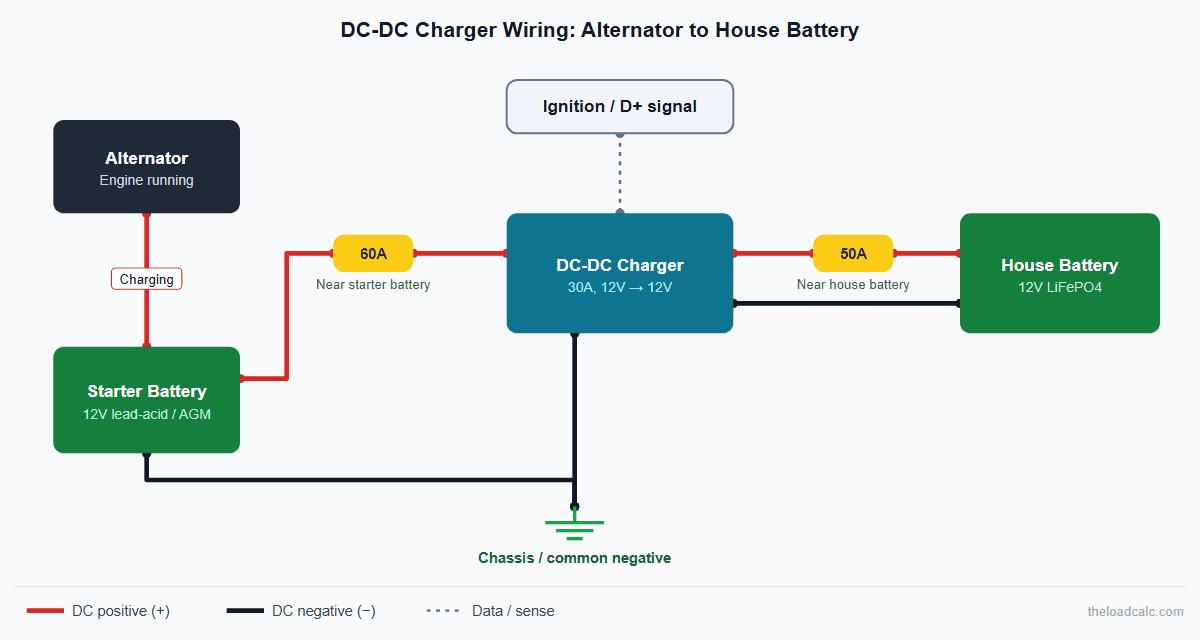
A DC-DC charger takes power from your vehicle's starter battery while the engine runs and charges a separate house battery with the correct voltage and current. It protects the alternator from the huge current a lithium battery would otherwise pull, works with modern "smart" alternators, and keeps the starter battery isolated when the engine is off.
Key takeaways
- Fuse the input cable near the starter battery and the output cable near the house battery.
- Size input cables for the input current, which is higher than the rated output.
- Connect the ignition (D+) wire if your vehicle has a smart or variable-voltage alternator.
- Use a solid negative return: a dedicated cable to the starter battery, or a verified chassis bond.
Components
| Component | Typical spec | Role |
|---|---|---|
| DC-DC charger | 20-50A, 12V in / 12V out | Regulates charging from the alternator |
| Input fuse | Per manual, typically 50-60A for a 30A charger | Protects the cable from the starter battery |
| Output fuse | Per manual, typically 40-50A | Protects the cable at the house battery |
| Cable | 6 AWG for runs up to ~15 ft at 30A; 4 AWG for longer | Keeps voltage drop under 3% |
| Ignition / D+ wire | 18-16 AWG, small inline fuse | Tells the charger the engine is running |
Step-by-step wiring
- 1Mount the charger close to the house battery, on a non-flammable surface with airflow around it.
- 2Run the positive input cable from the starter battery, through a fuse within about 7 inches (18 cm) of the battery post, to the charger input.
- 3Connect the charger output to the house battery positive through a fuse placed close to that battery.
- 4Connect the charger negative to the house battery negative (or the negative bus), and make sure the house negative is bonded back to the starter battery negative or chassis with an equal-size cable.
- 5Connect the ignition or D+ signal wire to a switched-ignition source if the charger needs it.
- 6Set the charge profile to match your house battery (LiFePO4, AGM or flooded), then test with the engine running.
Disconnect all sources before working, follow the equipment manuals and local electrical codes, and use a licensed electrician for work on home wiring and panels.
Why input current is higher than output
A 30A charger delivering 14.4V to a lithium battery outputs about 430W. If the input voltage sags to 12.5V and the charger is 95% efficient, input current is about 430 ÷ 12.5 ÷ 0.95 ≈ 36A. Size the input cable and fuse for that, not for the 30A label. Check your run with the voltage drop calculator and solar wire size calculator.
Long runs from an engine bay to the rear of a van often need one size thicker cable than you expect. A charger starved of voltage throttles back or shuts down.
Smart alternators and the ignition wire
Many vehicles built since the mid-2010s lower alternator voltage once the starter battery is full. A basic charger that waits for 13.2V+ never switches on. Chargers with a smart-alternator mode use the ignition or D+ signal instead of voltage to decide when to charge. If your vehicle has start-stop or a variable-voltage alternator, use this mode.
For the bigger picture of charging on the road, see charging a power station from your car, and for a complete van layout, see the campervan electrical diagram.
Common mistakes
- Fusing only one end. Both ends connect to a battery, so both ends need a fuse.
- Relying on a thin factory chassis ground. Add a dedicated negative cable for high currents.
- Using the wrong charge profile. LiFePO4 needs its own settings.
- Mounting the charger in the engine bay where heat derates it.
Frequently asked questions
Do I need a DC-DC charger for a lithium house battery?
Yes, in most vehicles. LiFePO4 can draw more current than an alternator can safely supply for long periods, and smart alternators may not supply enough voltage. A DC-DC charger limits current and provides the right charge profile.
Where should the DC-DC charger be mounted?
Close to the house battery, so the output cable is short. The longer input cable then carries current at a higher tolerance for voltage drop.
What size fuse do I need for a DC-DC charger?
Follow the manufacturer's table. For a 30A charger, the input fuse is commonly 50-60A and the output fuse 40-50A.
Size the cables for your run
Check voltage drop and wire gauge before you buy cable.
Related diagrams and guides
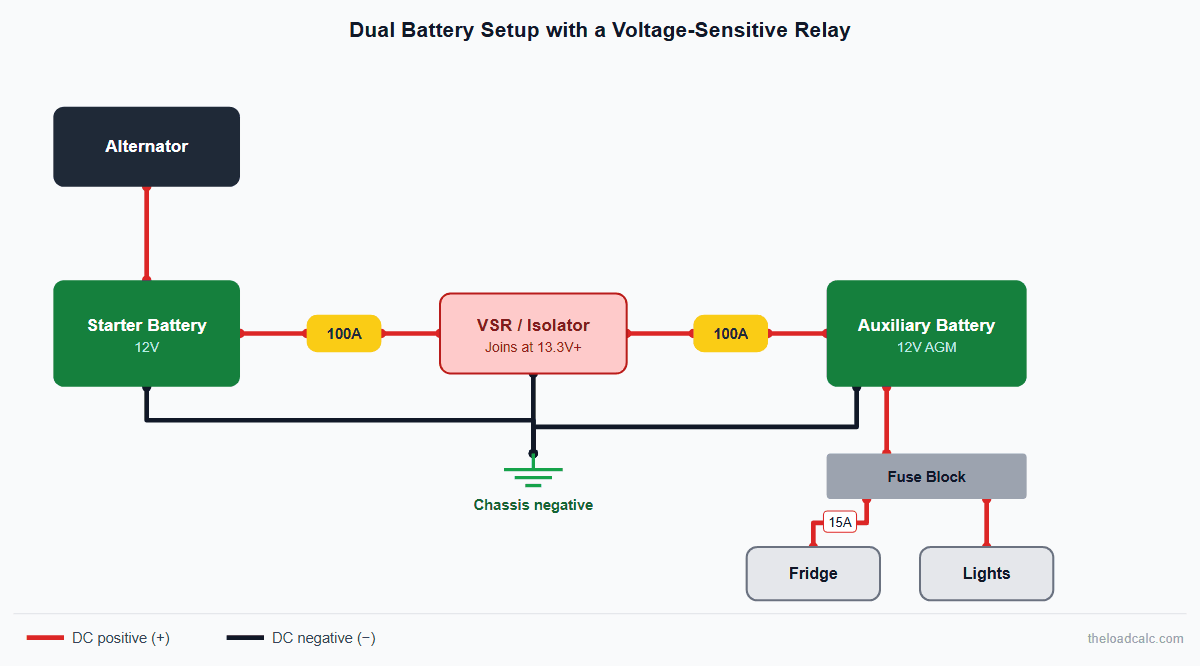
Dual Battery Wiring Diagram with a VSR / Isolator
A simple auxiliary battery for a fridge and lights that charges while you drive and never flattens your starter battery.
Read more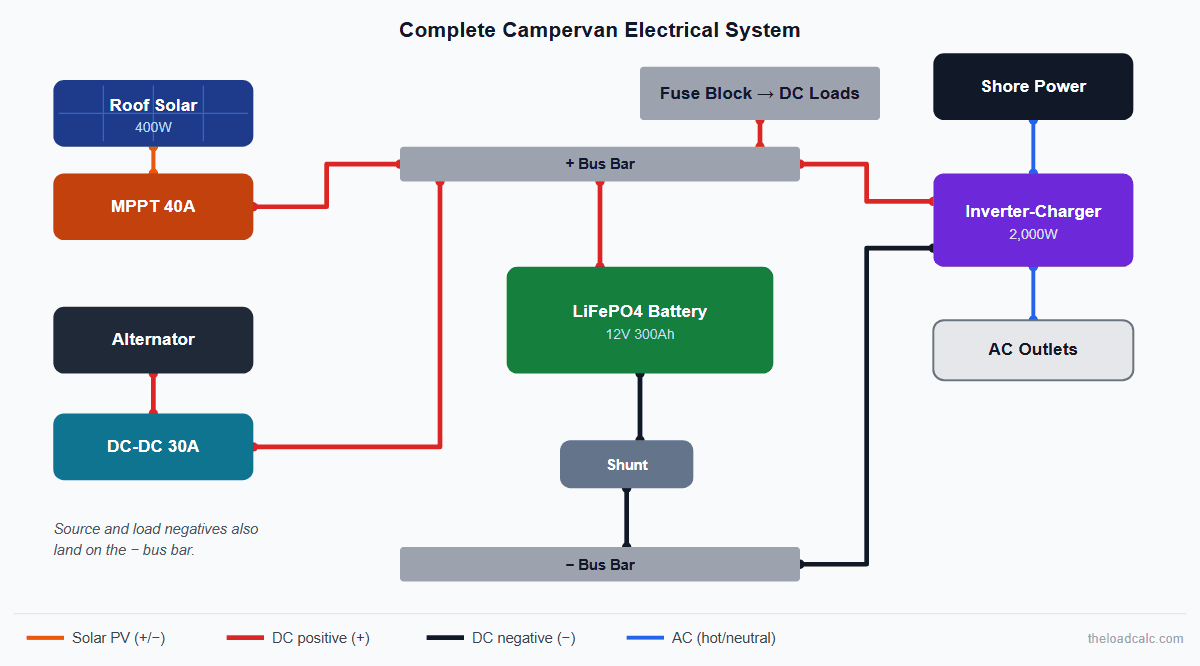
Complete Campervan Electrical Wiring Diagram
Solar, alternator and shore charging into one LiFePO4 battery, with bus bars, shunt, fuse block and inverter-charger.
Read more
Upgrading Your RV to Lithium Batteries: A Complete Guide
Swapping lead-acid for LiFePO4 is more than a battery swap. Chargers, the alternator and monitoring all need attention.
Read more
Charging a Power Station From Your Car: 12V Socket vs Alternator Charger
Charging while you drive sounds free. Through a cigarette-lighter socket it is painfully slow. Here is the math, and the faster wired alternative.
Read more