
Dual Battery Wiring Diagram with a VSR / Isolator
A simple auxiliary battery for a fridge and lights that charges while you drive and never flattens your starter battery.
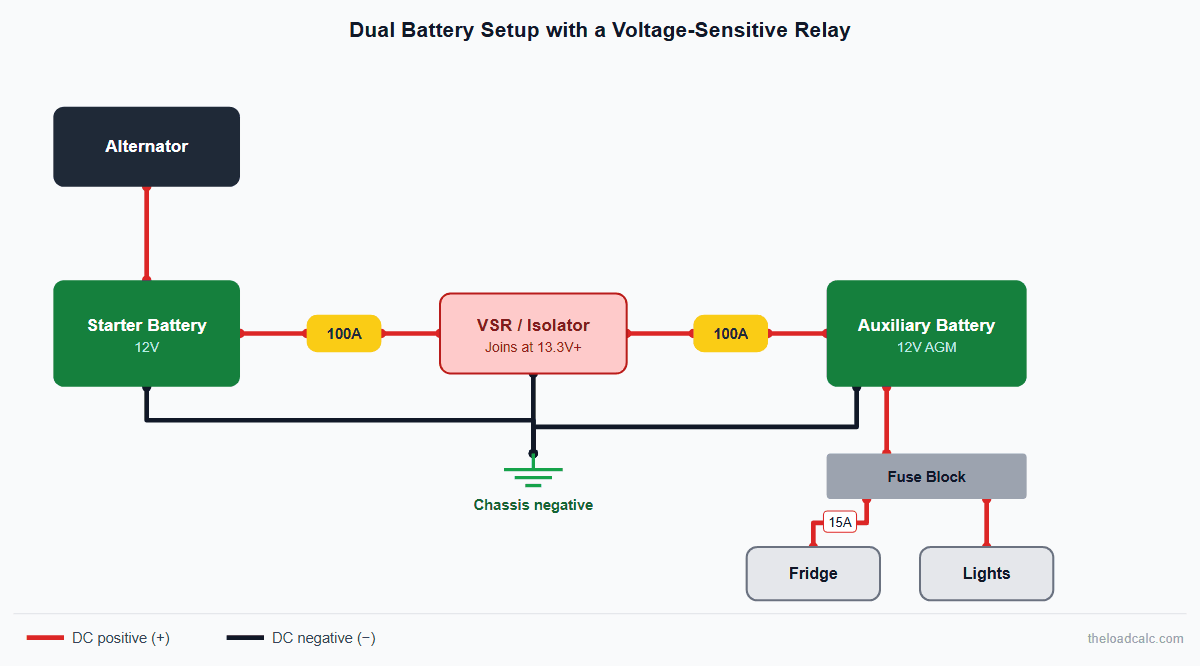
A dual battery setup adds a second battery to a truck, 4x4 or van for a fridge, lights and accessories. A voltage-sensitive relay (VSR) joins the two batteries when the engine is charging and separates them when it is not, so you can never flatten the starter battery by running the fridge overnight.
Key takeaways
- The VSR connects the batteries above about 13.3V and disconnects them below about 12.8V.
- Fuse both sides of the VSR, because current can flow in either direction.
- A VSR suits lead-acid or AGM auxiliary batteries. For lithium, use a DC-DC charger.
- Run accessories from a fuse block on the auxiliary battery, never straight off the battery post.
Components
| Component | Typical spec | Role |
|---|---|---|
| Voltage-sensitive relay | 100-140A continuous | Joins and separates the batteries automatically |
| Fuses (2) | 80-100A, MRBF or ANL | Protect the cable at each battery |
| Interconnect cable | 6-4 AWG depending on length | Carries charging current between batteries |
| Auxiliary battery | 12V AGM or flooded deep-cycle | Powers accessories |
| Fuse block | 6-12 circuits with a negative bus | Distributes power to the fridge, lights and sockets |
Step-by-step wiring
- 1Mount the auxiliary battery securely in a vented box or tray rated for vehicle use.
- 2Fit a fuse within about 7 inches of the starter battery positive and run the interconnect cable to the VSR.
- 3Connect the other side of the VSR to the auxiliary battery through a second fuse near that battery.
- 4Connect the VSR negative (for its electronics) to chassis ground.
- 5Bond the auxiliary battery negative to the chassis or back to the starter battery with cable equal in size to the positive.
- 6Feed a fuse block from the auxiliary battery and connect accessories to individual fused circuits. See the fuse block diagram.
Disconnect all sources before working, follow the equipment manuals and local electrical codes, and use a licensed electrician for work on home wiring and panels.
VSR or DC-DC charger?
| VSR / isolator | DC-DC charger | |
|---|---|---|
| Best with | AGM or flooded aux battery | LiFePO4, or any battery with a smart alternator |
| Charge control | None, just alternator voltage | Full multi-stage profile |
| Cost | Low | Higher |
| Smart alternators | Often charges poorly | Works with ignition trigger |
If you plan to run a 12V fridge off a lithium battery, skip the VSR and follow the DC-DC charger diagram instead.
Common mistakes
- Pairing a VSR with a lithium auxiliary battery, which can overload the alternator.
- Fusing only at the starter battery end.
- Using undersized cable, so the auxiliary battery never fully charges.
- Mounting a flooded battery inside the cabin without venting.
Frequently asked questions
How does a voltage-sensitive relay work?
It monitors voltage. When the engine runs and voltage rises above a set point (typically around 13.3V), it closes and links the batteries. When voltage falls (typically around 12.8V), it opens and isolates them.
Can I use a VSR with a lithium battery?
It is not recommended. Lithium batteries can pull very high current from the alternator. Use a DC-DC charger.
Do I need to fuse both ends of the cable between batteries?
Yes. Both ends connect to a battery that can deliver fault current, so each end needs a fuse close to the battery.
Size your auxiliary battery
Work out how many amp-hours your fridge and accessories need.
Related diagrams and guides
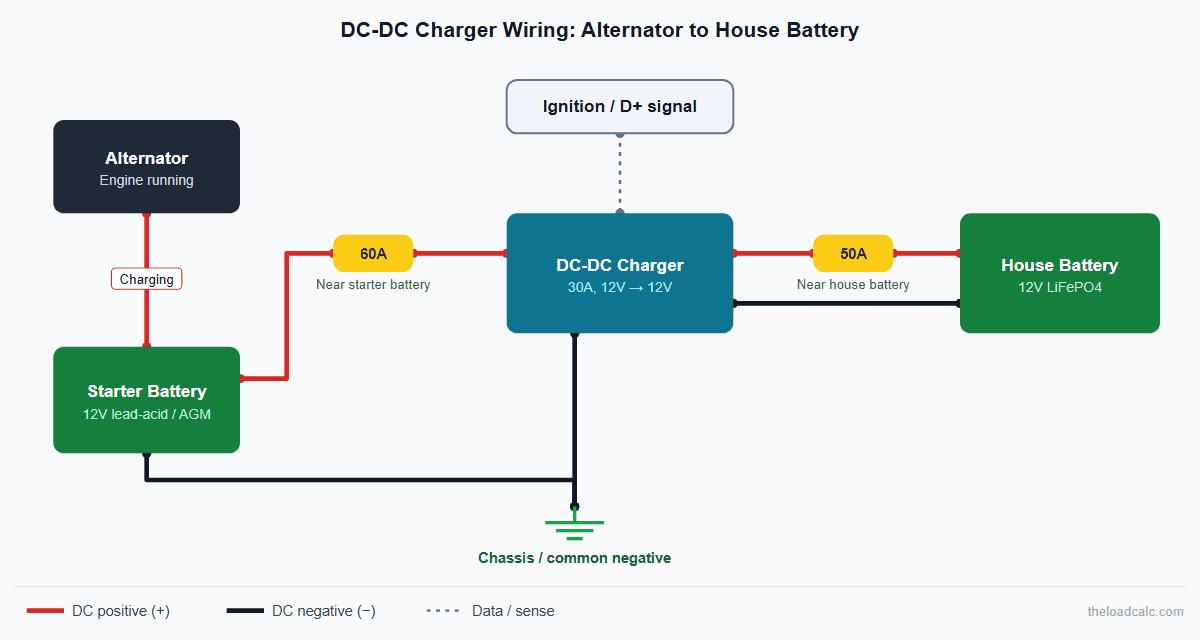
DC-DC Charger Wiring Diagram: Alternator to House Battery
Charge a lithium house battery safely from your alternator, with fuse locations, cable sizes and the ignition trigger.
Read more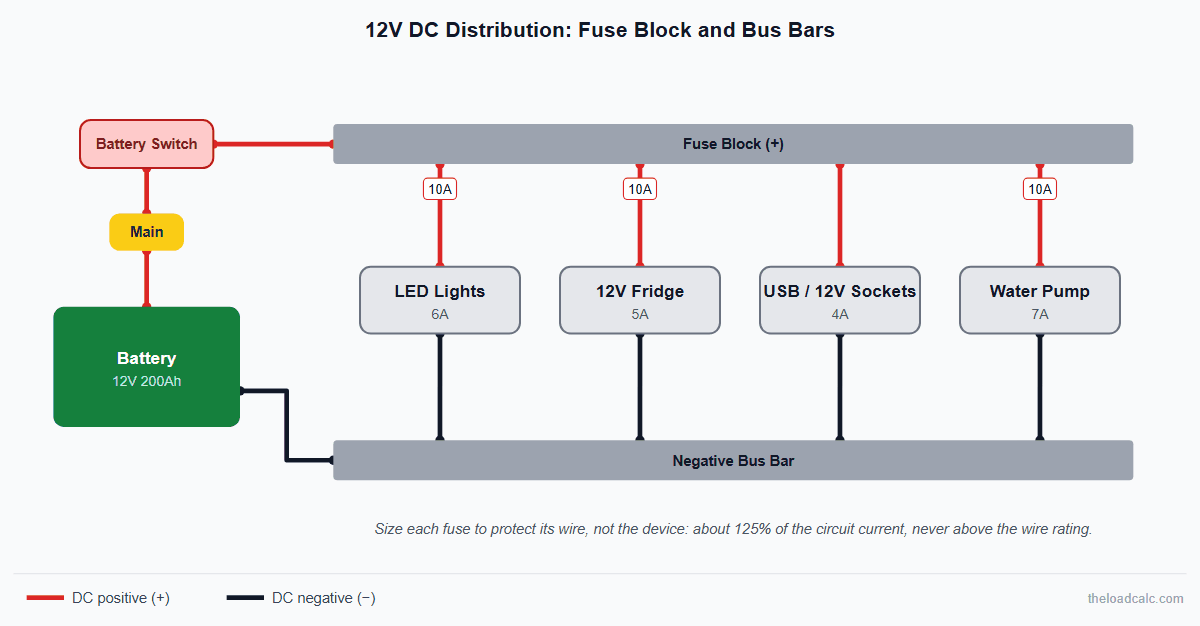
12V Fuse Block and Bus Bar Wiring Diagram
Distribute 12V power to lights, fridge, pump and sockets, each on its own correctly sized fuse.
Read more
Powering a 12V Fridge Off-Grid: Battery and Solar Sizing
A compressor fridge is the biggest daily load in most camper and overland setups. Real consumption figures and a sizing method that keeps food cold.
Read more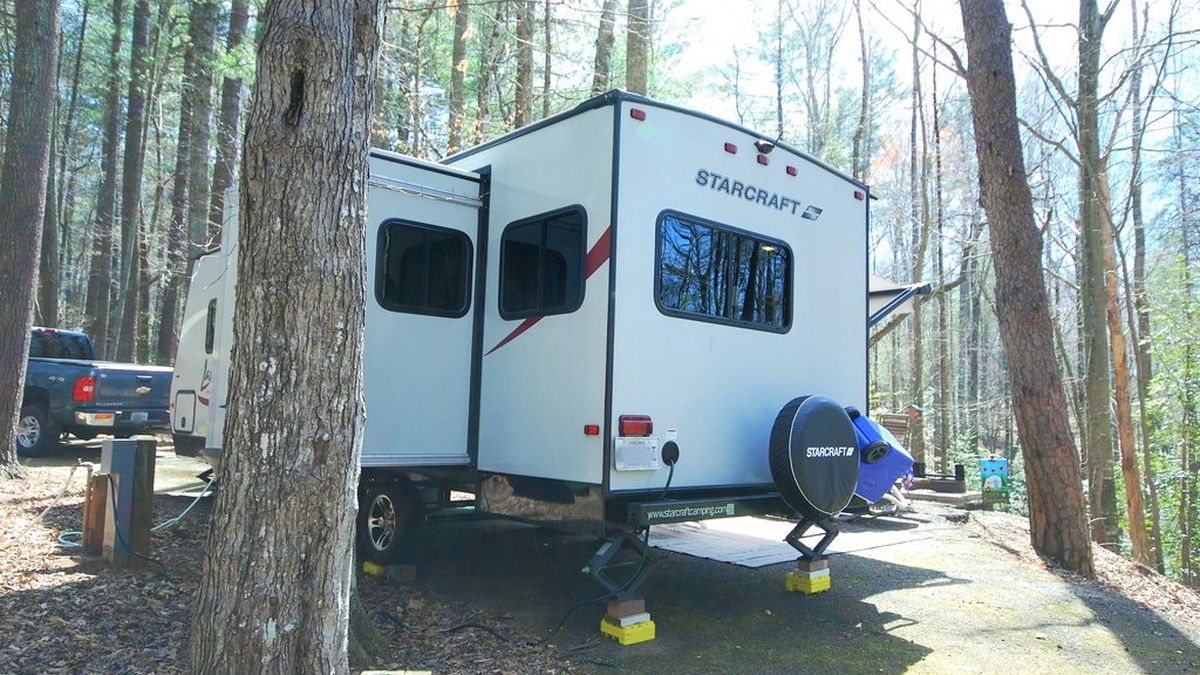
Upgrading Your RV to Lithium Batteries: A Complete Guide
Swapping lead-acid for LiFePO4 is more than a battery swap. Chargers, the alternator and monitoring all need attention.
Read more
Boat Solar Power: Panels, Batteries and Marine Wiring
Arches, biminis and rails: how to add solar to a boat, size it for days at anchor, and wire it to survive salt and vibration.
Read more