
Boat Solar Power: Panels, Batteries and Marine Wiring
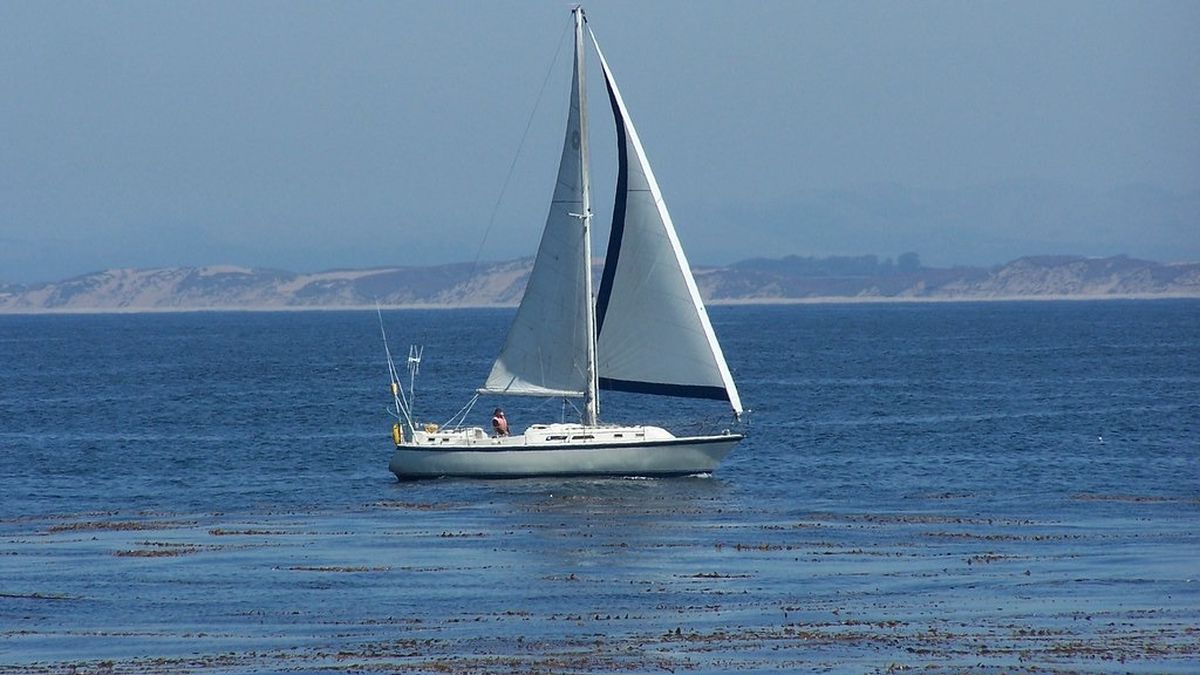
Solar can keep a boat's house bank topped up at anchor and on a mooring, running the fridge, electronics and lights without running the engine. Boats bring their own challenges: limited mounting space, shading from rigging, salt and vibration. Here is how to plan, mount and wire a marine solar system.
Key takeaways
- Mount panels on an arch, bimini, dodger or rails, wherever they get least shade from the boom and rigging.
- Size for daily anchor loads; fridges and autopilots dominate.
- Use tinned wire, marine-grade connectors and fuses close to the battery.
- Charge the house bank and protect the start battery with an ACR or DC-DC charger.
Typical daily loads at anchor (12V)
| Load | Ah/day |
|---|---|
| Refrigerator | 40-70 |
| Anchor light (LED) | 2-4 |
| Cabin lights (LED) | 5-10 |
| Electronics, phones, laptop | 10-25 |
| Water pump | 2-5 |
| Autopilot (sailing) | 30-100+ |
| Typical cruising total at anchor | 70-120 |
A 100Ah/day boat needs roughly 300-400W of panels in sunny cruising grounds. See the 12V fridge guide for the biggest load.
Mounting options
| Location | Pros | Cons |
|---|---|---|
| Stern arch / gantry | Little shade, rigid panels, big area | Cost, windage |
| Bimini top | Uses existing structure | Flexible panels run hot and degrade faster |
| Rails | Adjustable angle | Shade from rigging, smaller panels |
| Deck | Simple | Shading, foot traffic |
Shade from the boom or rigging is unavoidable on sailboats. Wire panels in parallel or give each panel its own controller so one shaded panel does not drag down the others. See the shading impact calculator.
Marine wiring practice
- Tinned copper wire and adhesive-lined heat shrink on every connection.
- Deck glands for cable entries; drip loops before them.
- Overcurrent protection close to the battery, per ABYC guidance.
- Mount controllers in dry, ventilated spaces.
The marine dual bank diagram shows how the house and start banks connect, and the battery monitor diagram shows how to track house bank usage.
Batteries
AGM is still common, but LiFePO4 house banks offer double the usable capacity at half the weight. Lithium on boats needs attention to alternator charging and BMS disconnects. See how to choose solar batteries and size the bank with the battery autonomy calculator.
Frequently asked questions
How much solar do I need on a sailboat?
Many cruising sailboats use 300-600W to cover a 70-120Ah daily load, depending on climate and whether an autopilot runs often.
Are flexible solar panels good for boats?
They fit biminis and curved surfaces, but run hotter and usually degrade faster than rigid panels. Use rigid panels where you can.
Should solar charge the start battery too?
Connect solar to the house bank. An ACR or charger can share surplus with the start battery.
Size your house bank
Work out battery and solar needs for days at anchor.
Related guides and diagrams
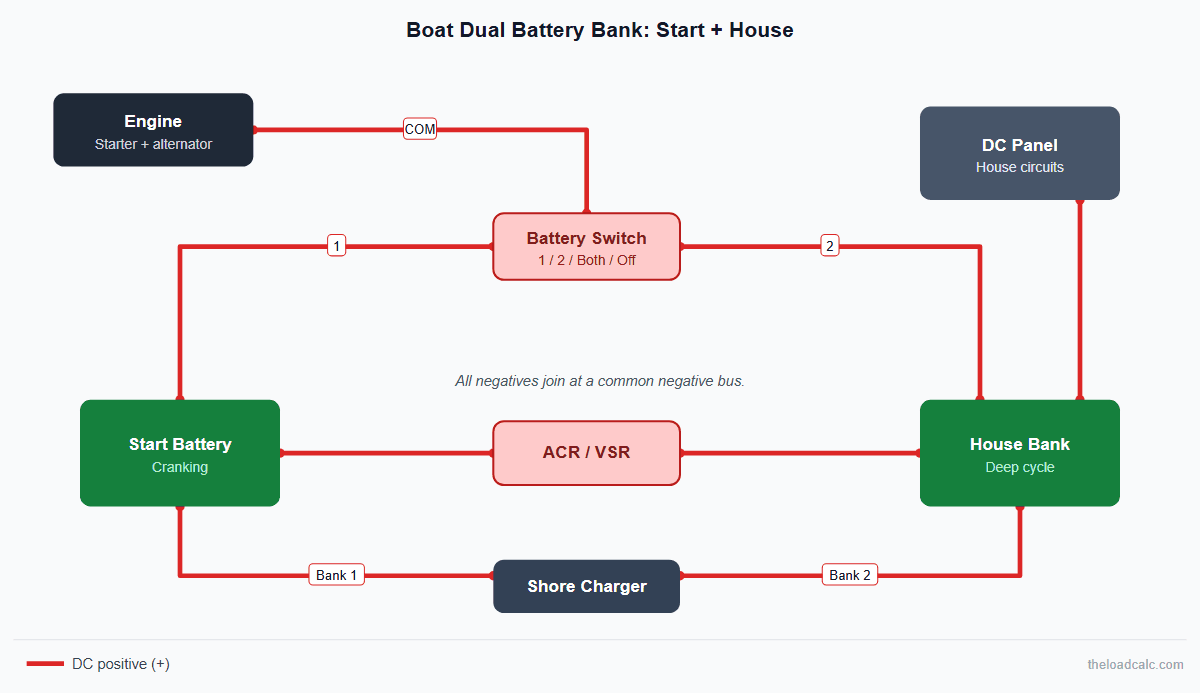
Boat Dual Battery Wiring Diagram: Start and House Banks
Keep the engine starting no matter how much the house bank is used, with a selector switch and an automatic charging relay.
Read more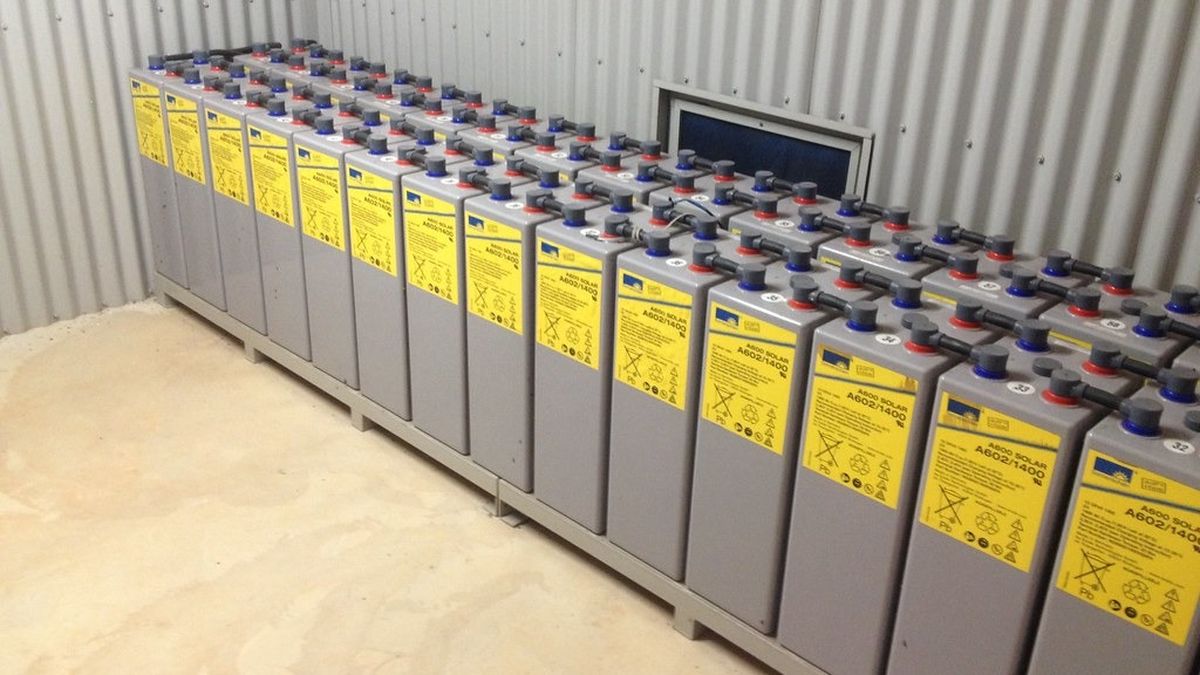
How to Choose Solar Batteries: LiFePO4, AGM and Server-Rack Packs
Chemistry, usable capacity, BMS features and lifetime cost per kWh: a practical framework for choosing the battery your system depends on.
Read more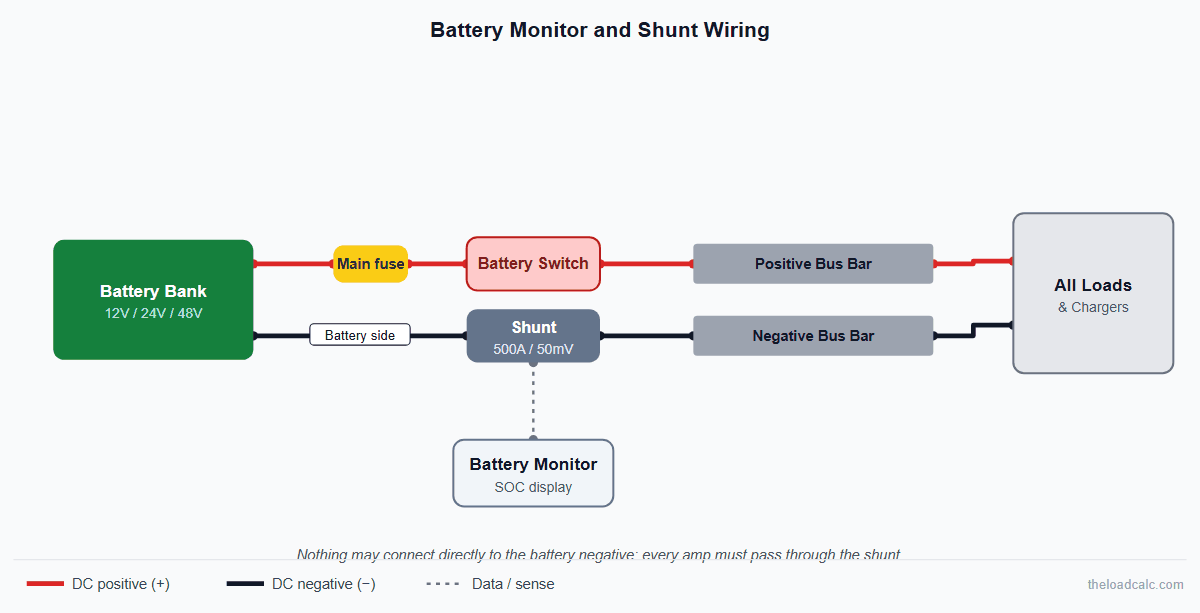
Battery Monitor Shunt Wiring Diagram
Wire a shunt so every amp in and out of the battery is counted, and your state-of-charge reading stays accurate.
Read more
Powering a 12V Fridge Off-Grid: Battery and Solar Sizing
A compressor fridge is the biggest daily load in most camper and overland setups. Real consumption figures and a sizing method that keeps food cold.
Read more