
12V vs 24V vs 48V: Choosing Your Solar System Voltage
The nominal voltage of your battery bank, 12V, 24V or 48V, shapes every other part of an off-grid build: cable sizes, fuses, charge controller choice, inverter options and cost. It is also the hardest decision to change later. The good news is that one simple rule covers most systems.
Key takeaways
- Power = volts × amps. Doubling voltage halves the current for the same power.
- Lower current means thinner, cheaper cables and less energy lost as heat.
- Rule of thumb: under 1,500W → 12V; 1,500-3,000W → 24V; over 3,000W or whole-home → 48V.
- Vehicles and small campers usually stay 12V to match the vehicle electrical system.
It all comes down to current
For a given amount of power, current falls as voltage rises: amps = watts ÷ volts. Here is a 3,000W inverter at full load, assuming 90% efficiency (3,333W drawn from the battery):
| System voltage | Battery current | Typical cable (short run) | Main fuse |
|---|---|---|---|
| 12V (12.8V) | ~260A | 4/0 AWG | 300-400A |
| 24V (25.6V) | ~130A | 1/0-2/0 AWG | 150-200A |
| 48V (51.2V) | ~65A | 4-6 AWG | 80-100A |
At 12V you are dealing with welding-cable sizes, expensive lugs and crimpers, and noticeable voltage drop. At 48V, the same power runs through cable you could bend by hand. Check your own runs with the voltage drop calculator and solar wire size calculator.
Charge controllers get more capable at higher voltage
A charge controller is rated in amps on the battery side, so the solar power it can handle scales with battery voltage:
| MPPT controller | At 12V | At 24V | At 48V |
|---|---|---|---|
| 30A | ~390W | ~780W | ~1,560W |
| 40A | ~520W | ~1,040W | ~2,080W |
| 60A | ~780W | ~1,560W | ~3,120W |
Going from 12V to 48V lets one controller handle four times the array. See MPPT vs PWM charge controllers for why MPPT is essential at these sizes, and use the charge controller sizing calculator.
When each voltage makes sense
| 12V | 24V | 48V | |
|---|---|---|---|
| Inverter size | Up to ~1,500W | 1,500-3,000W | 3,000W and up |
| Typical use | Vans, small RVs, boats, sheds | Large RVs, cabins, workshops | Tiny homes, off-grid houses, whole-home backup |
| Pros | Matches vehicle systems; huge range of 12V appliances | Good middle ground; moderate cable sizes | Lowest current; most efficient; widest inverter choice |
| Cons | Heavy cables at high power | Fewer 24V appliances; needs a converter for 12V loads | Needs a DC-DC converter for 12V loads; more care with voltage safety |
Need 12V loads like lights or a fridge on a 24V or 48V system? A DC-DC step-down converter (typically 90-95% efficient) feeds them easily.
Building the bank
You reach higher voltages by wiring batteries in series: two 12V batteries make 24V, four make 48V. Many manufacturers also sell native 24V and 48V LiFePO4 batteries and server-rack modules, which avoid series balancing issues. The battery series/parallel calculator shows the combinations, and our wiring diagrams cover 12V, 24V and 48V systems.
Only connect identical batteries (same model, age and state of charge) in series, and check the manufacturer allows series connection and the maximum number in series.
Putting it into practice
A 48V system is the default for anything house-sized. Our tiny house solar sizing example walks through one. If you need 240V for a well pump, split-phase inverter-chargers are almost always 48V. For vans and campers, 12V keeps things simple. Pair it with an alternator charger as in charging from your car.
Whatever voltage you choose, size the array for real output, not label watts. See why solar panels produce less than rated.
Frequently asked questions
Is 24V better than 12V for solar?
For systems above about 1,500W, yes. Current is halved, so cables are thinner, losses lower and the same charge controller handles twice the solar power.
Can I run 12V appliances on a 48V system?
Yes, with a DC-DC step-down converter sized for the 12V loads, or by running them from the inverter's AC output with their own adapters.
Can I change my system from 12V to 24V later?
Usually only by replacing the inverter, often the charge controller and DC loads, and rewiring the batteries. That is why it pays to choose the voltage for where the system will end up.
Size your off-grid system
Get panel, battery and inverter sizes for 12V, 24V or 48V.
Keep reading
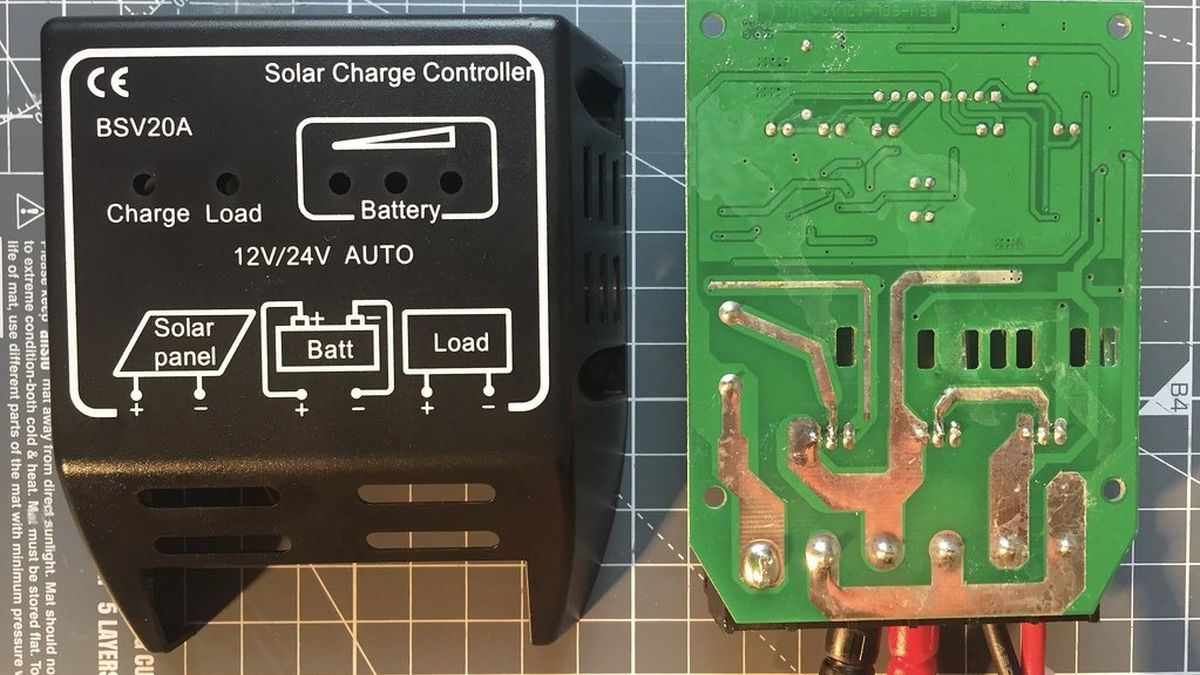
MPPT vs PWM Charge Controllers: Is MPPT Worth the Money?
A PWM controller can throw away a quarter of your panel output. We show the math for a 100W panel and explain when the cheaper controller is still the right call.
Read more
Tiny House Solar System Sizing: A Complete Worked Example
We size a full off-grid system for a typical tiny house, from the appliance list to the battery bank, so you can repeat the process with your own numbers.
Read more
How to Run a Well Pump During a Power Outage
No power means no water on a private well. A well pump uses little energy but a lot of startup current, and that changes what kind of backup you need.
Read more
Why Your Solar Panel Produces Less Than Its Rated Watts
Seeing 70W from a 100W panel is normal, not a fault. Here is where the missing watts go and the number to plan with instead of the label.
Read more