
East-West Split Array Wiring Diagram (Dual MPPT)
Panels on two roof faces? Give each orientation its own MPPT input and a flatter, longer production curve.
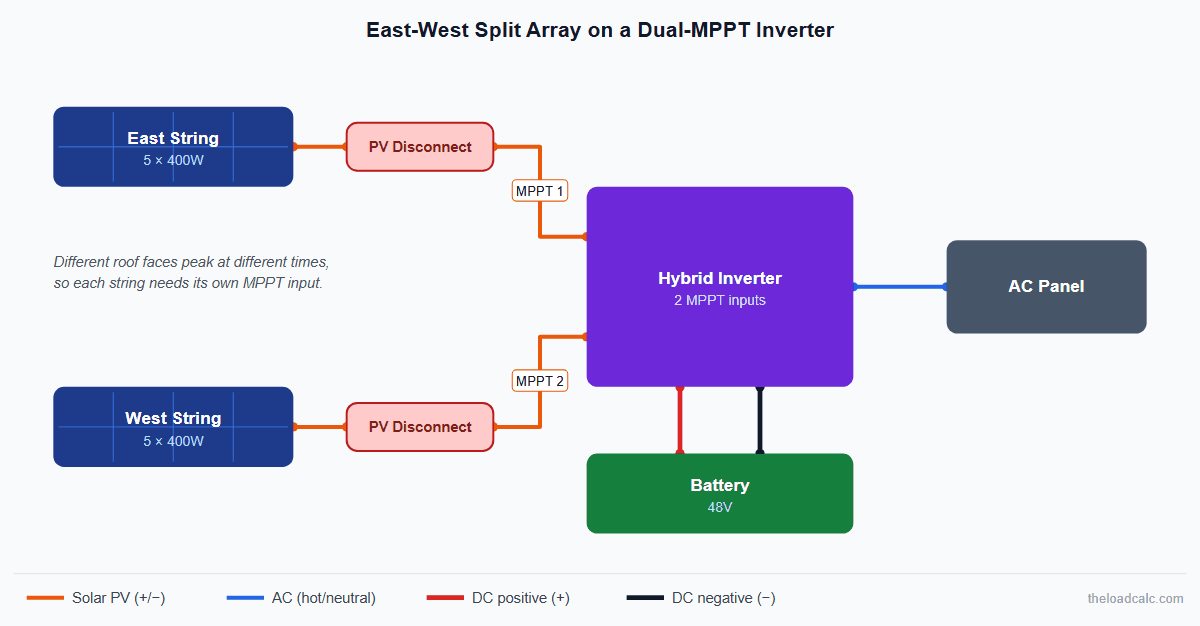
Many roofs do not have one big south face. Splitting panels between east and west roof faces is common and works well, as long as each orientation has its own MPPT input. East panels peak in the morning and west panels in the afternoon, so mixing them on one tracker would leave both operating below their best.
Key takeaways
- Each orientation gets its own MPPT input (or its own controller).
- Panels within a string must share the same orientation and model.
- East-west arrays typically produce somewhat less annual energy than due south, but spread over more hours.
- Check each string's cold-weather voltage against the input limit.
Components
| Component | Typical spec | Role |
|---|---|---|
| East string | Panels facing east, same model | Morning production |
| West string | Panels facing west, same model | Afternoon production |
| PV disconnects | Rated for string voltage and current | Isolation for service |
| Dual-MPPT inverter or two controllers | Inputs sized per string | Independent tracking |
| Battery and AC panel | Per system design | Storage and distribution |
Step-by-step wiring
- 1Design each string from panels on one roof face only, within the MPPT voltage window.
- 2Run each string to its own disconnect, then to its own MPPT input.
- 3Label strings clearly at the disconnects and the inverter.
- 4Connect the battery and AC output per the inverter manual.
- 5Commission and confirm each MPPT reports its own string's voltage and power.
Disconnect all sources before working, follow the equipment manuals and local electrical codes, and use a licensed electrician for work on home wiring and panels.
What to expect from east-west
At typical mid-latitudes, an east-west split usually produces roughly 10-20% less annual energy than the same panels facing due south. The peak is lower but production starts earlier and runs later, which suits households that use power in the morning and evening, and reduces how much battery storage you need for those hours. Estimate the impact with the azimuth loss calculator.
Series wiring for each string is covered in the series panel wiring diagram. For how real-world losses add up, see why panels produce less than rated.
Common mistakes
- Mixing east and west panels in one series string.
- Paralleling an east string and a west string into one MPPT input.
- Unequal string lengths on inputs that are paralleled internally.
- Ignoring cold-morning Voc on the higher-voltage string.
Frequently asked questions
Can I put east and west panels on the same MPPT?
It is not recommended in series. Some installers parallel identical east and west strings on one MPPT with acceptable losses, but separate inputs are the clean solution.
Is an east-west solar array worth it?
Often yes. It fits more panels on many roofs and matches morning and evening use, at the cost of somewhat lower peak and annual output than due south.
How many MPPT inputs do I need?
One per distinct orientation or panel type. Many hybrid inverters have two or more.
Estimate orientation losses
See how direction and tilt affect your output.
Related diagrams and guides
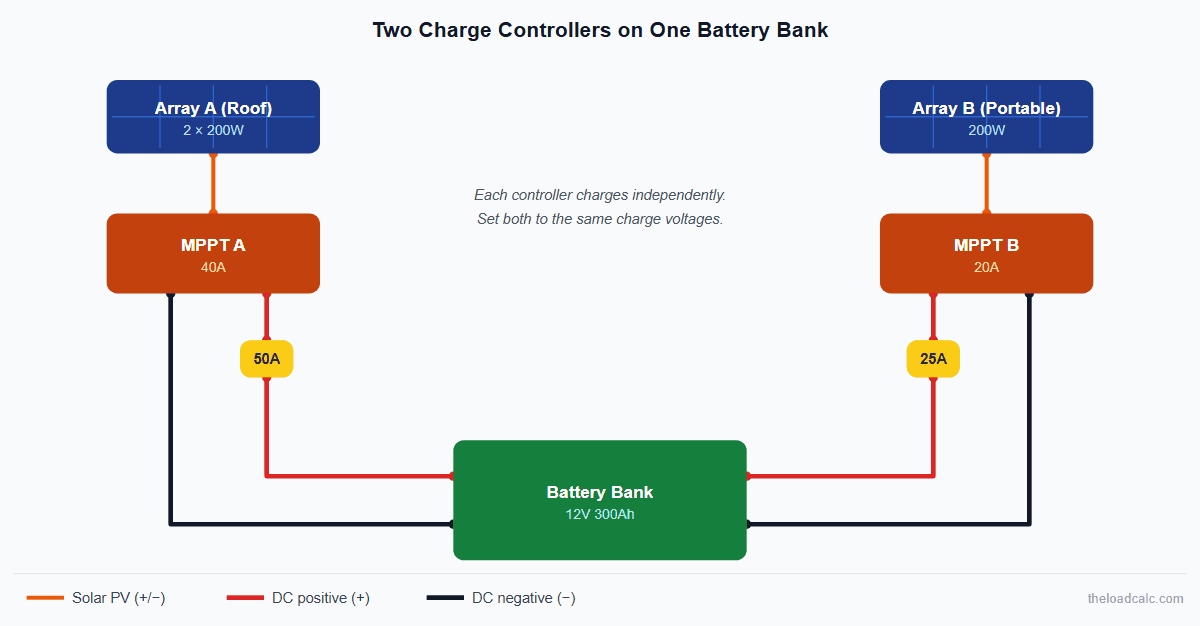
Two Charge Controllers on One Battery: Wiring Diagram
Two arrays, two controllers, one battery bank: how to wire it and keep the controllers from fighting.
Read moreSolar Panels in Series Wiring Diagram
How to wire solar panels in series to increase voltage, with a diagram and when series wiring is the right choice.
Read more
Grid-Tie vs Off-Grid vs Hybrid Solar: Which System Is Right for You?
The three ways to use solar at home, compared on cost, outage protection and complexity, so you can pick the right architecture.
Read more
Why Your Solar Panel Produces Less Than Its Rated Watts
Seeing 70W from a 100W panel is normal, not a fault. Here is where the missing watts go and the number to plan with instead of the label.
Read more