
Two Charge Controllers on One Battery: Wiring Diagram
Two arrays, two controllers, one battery bank: how to wire it and keep the controllers from fighting.
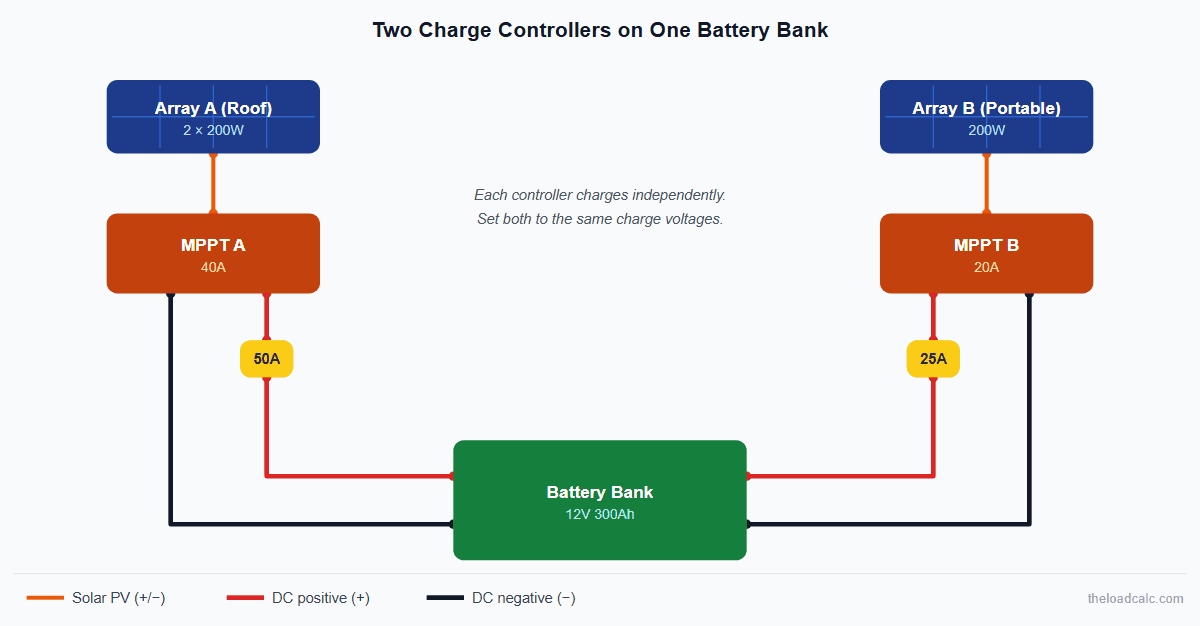
Adding a second solar array is a common upgrade, and often the easiest way is a second charge controller on the same battery. It is also the right approach when arrays face different directions, use different panels or sit far apart. The controllers do not need to talk to each other. Each simply charges the battery.
Key takeaways
- Each array gets its own controller; controllers connect in parallel at the battery or bus bar.
- Fuse each controller's battery cable close to the battery or bus.
- Set both controllers to the same absorption and float voltages.
- Two controllers make sense for different orientations, panel types or locations.
Components
| Component | Typical spec | Role |
|---|---|---|
| Controller A | Sized for array A | Charges from array A |
| Controller B | Sized for array B | Charges from array B |
| Fuses | One per controller output | Protect each controller cable |
| Battery bank or bus bars | Common connection | Receives both outputs |
Step-by-step wiring
- 1Size each controller for its own array's current and voltage. Use the charge controller sizing calculator.
- 2Connect each controller's battery terminals to the battery or bus bars, each through its own fuse.
- 3Program the same battery profile (absorption, float, temperature limits) on both controllers.
- 4Connect each array to its controller through a PV disconnect or breaker.
- 5Confirm both controllers report charging current in full sun.
Disconnect all sources before working, follow the equipment manuals and local electrical codes, and use a licensed electrician for work on home wiring and panels.
When two controllers beat one bigger controller
- Arrays facing different directions (roof and portable, or east and west).
- Different panel models with different voltages.
- Expanding a system without replacing the existing controller.
- Redundancy: if one controller fails, the other keeps charging.
For grid-tie or hybrid inverters with built-in MPPT inputs, the same principle applies. See the east-west array diagram. For single controller wiring, see the charge controller diagram, and for choosing a controller, see how to choose a charge controller.
Common mistakes
- Different charge voltages, so one controller stops early while the other keeps pushing.
- Sharing one fuse between two controllers.
- Connecting two arrays to one controller input when their voltages differ.
- Undersized cable from a controller far from the battery.
Frequently asked questions
Can I connect two charge controllers to one battery?
Yes. Connect each controller to the battery bank with its own fuse and set both to the same charge voltages.
Do the controllers need to be the same brand?
No, although same-brand controllers can sometimes network for synchronized charging. Matching voltage settings is what matters.
Will two controllers overcharge the battery?
No. Each controller regulates to its set voltage, and both reduce current as the battery approaches full.
Size each controller
Match each controller to its array.
Related diagrams and guides
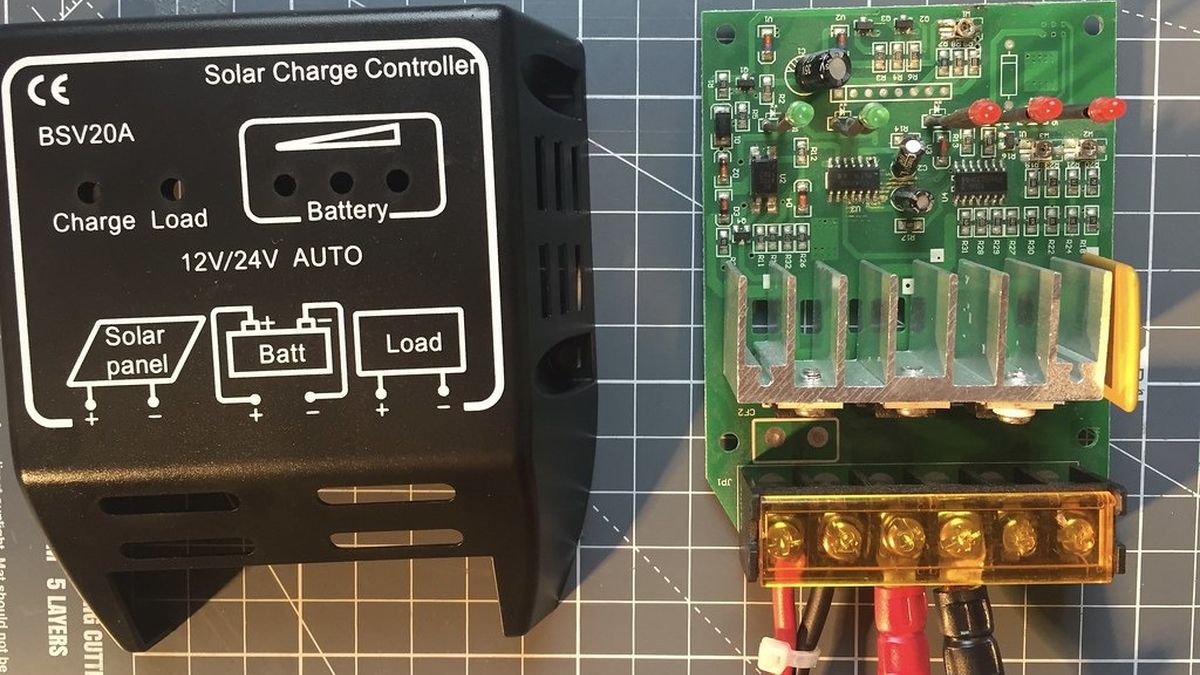
How to Choose a Solar Charge Controller
Current rating, maximum PV voltage, battery profiles and the cold-morning voltage check that protects your controller.
Read moreCharge Controller Wiring Diagram
How to connect a solar charge controller to your panels and battery bank in the right order, with fusing.
Read more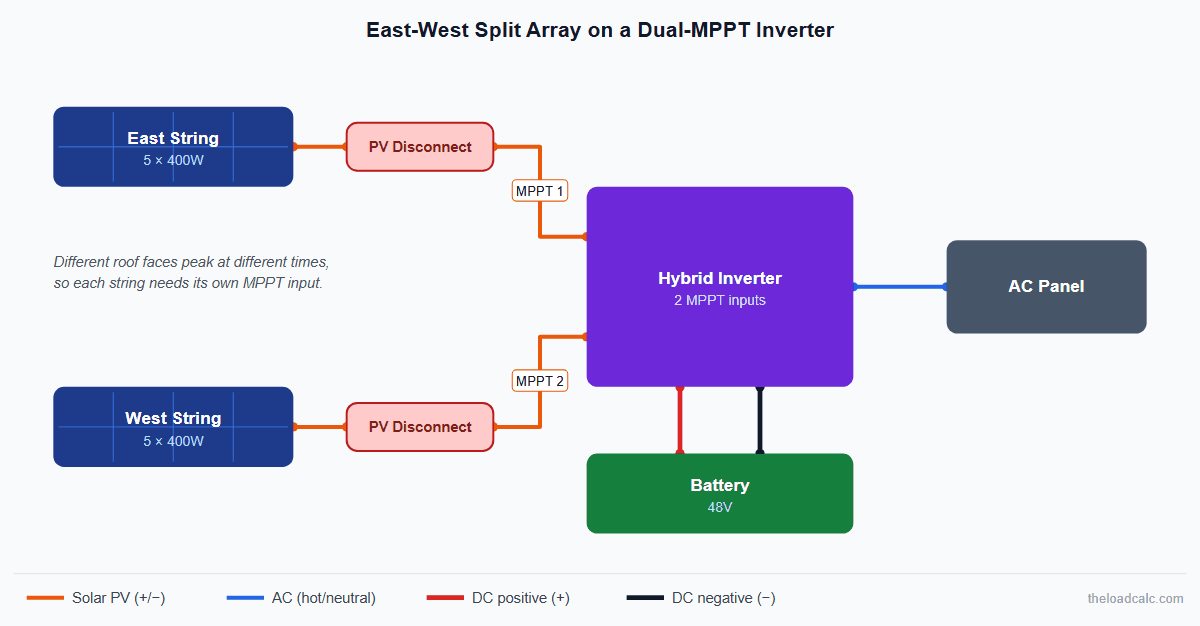
East-West Split Array Wiring Diagram (Dual MPPT)
Panels on two roof faces? Give each orientation its own MPPT input and a flatter, longer production curve.
Read more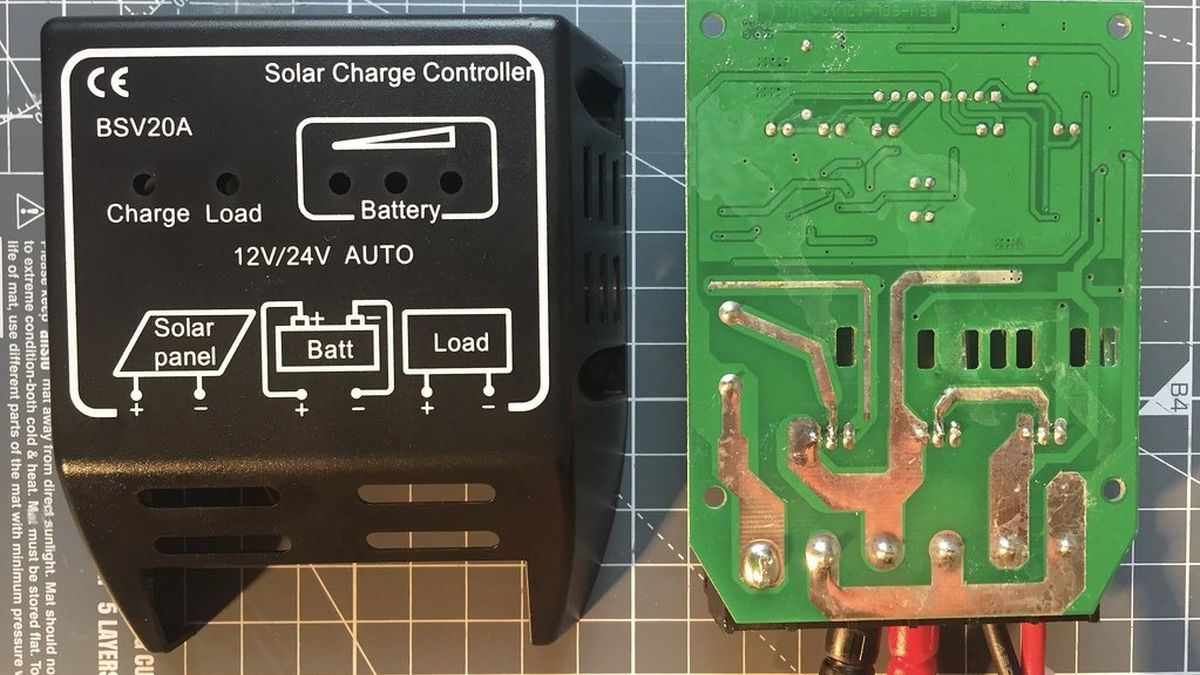
MPPT vs PWM Charge Controllers: Is MPPT Worth the Money?
A PWM controller can throw away a quarter of your panel output. We show the math for a 100W panel and explain when the cheaper controller is still the right call.
Read more