
Portable Solar Panels to Power Station Wiring Diagram
Series or parallel? How to connect two or more portable panels to a power station without exceeding its input limits.
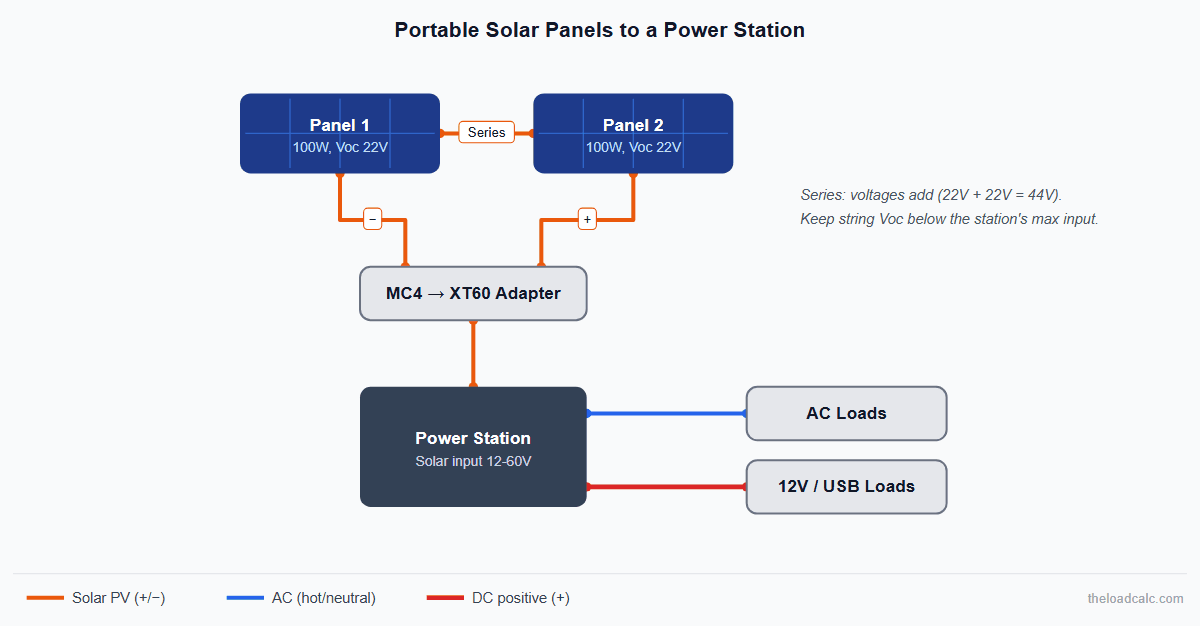
Connecting portable solar panels to a power station is simple, until you add a second panel. Series wiring adds voltage, parallel wiring adds current, and your power station has limits on both. This diagram shows two 100W panels in series feeding a typical 12-60V input.
Key takeaways
- Series: voltages add, current stays the same. Parallel: current adds, voltage stays the same.
- Keep total open-circuit voltage (Voc) below the station's maximum input voltage, with margin for cold weather.
- Keep total current below the station's input current limit.
- Use MC4 extension cables of 10-12 AWG and a proper adapter for the station's input connector.
Components
| Component | Typical spec | Role |
|---|---|---|
| Portable panels | Two 100W, Voc ~22V, Isc ~5.8A | Generate power |
| MC4 series connection | Panel 1 + to Panel 2 − | Adds voltages |
| MC4 extension cable | 10-12 AWG, as short as practical | Brings power to the station |
| Input adapter | MC4 to XT60 / Anderson / DC8020 | Matches the station's connector |
| Power station | Example: 12-60V, 10A, 200W input | Stores and delivers energy |
Step-by-step wiring
- 1Check the power station's solar input voltage range, current limit and maximum watts.
- 2Add up panel Voc for series (22V + 22V = 44V) or Isc for parallel (5.8A + 5.8A = 11.6A), and compare with the limits.
- 3For series: connect Panel 1 positive to Panel 2 negative. The remaining Panel 1 negative and Panel 2 positive are the string output.
- 4Connect the string output to the extension cable and adapter, observing polarity.
- 5Plug into the power station and confirm the input reading in sun.
Disconnect all sources before working, follow the equipment manuals and local electrical codes, and use a licensed electrician for work on home wiring and panels.
Series or parallel?
| Series | Parallel | |
|---|---|---|
| Voltage | Adds (44V) | Same (22V) |
| Current | Same (5.5A) | Adds (11A) |
| Cable losses | Lower | Higher |
| Partial shade | One shaded panel drags the string | More tolerant |
| Typical use | Wide-range inputs (12-60V+) | Low-voltage inputs or high current limits |
More detail: series panel wiring and parallel panel wiring. Choosing panels in the first place? See the portable solar panel buying guide.
Panel Voc rises in cold weather, roughly 10-15% on a freezing morning. Leave that margin below your station's maximum input voltage. Use the PV string voltage calculator.
Common mistakes
- Exceeding the maximum input voltage with too many panels in series.
- Using thin, long extension cables.
- Mixing panels with very different voltages or currents.
- Reversing polarity at the adapter.
Frequently asked questions
Should I connect solar panels to a power station in series or parallel?
Series if the combined voltage stays within the input range, as it reduces cable losses. Parallel if the input voltage range is narrow, or panels will be shaded unevenly.
Can I connect different solar panels together?
It is best to use identical panels. Different panels in series are limited by the lowest current; in parallel, by the lowest voltage.
How long can my solar extension cable be?
As short as practical. For 10A at around 40V, 10 AWG keeps losses low up to about 30-50 feet. Check with the cable loss calculator.
Check your string
Verify voltage and cable losses before you connect.
Related diagrams and guides
Portable Solar Panel Buying Guide: Folding vs Rigid and What Specs Matter
The wrong panel either cannot recharge your power station in a day or will not plug into it at all. The specs that matter, and the ones that are just marketing.
Read moreSolar Panels in Series Wiring Diagram
How to wire solar panels in series to increase voltage, with a diagram and when series wiring is the right choice.
Read moreSolar Panels in Parallel Wiring Diagram
How to wire solar panels in parallel to increase current, with a diagram and when parallel wiring is the right choice.
Read more
Solar Power for Apartments and Renters
No roof, no problem: balcony panels, power stations and community solar options for renters, with realistic output numbers.
Read more