
Solar Fuse and Breaker Sizing: Protecting Every Wire
Fuses and breakers exist to protect wires. Batteries can deliver thousands of amps into a short circuit, enough to turn an unprotected cable into a heating element in seconds. Every positive conductor leaving a battery needs overcurrent protection sized for that conductor and installed close to the battery.
Key takeaways
- Size fuses to protect the wire: at or below its ampacity, typically 125% of normal current.
- Place battery fuses as close to the battery as practical.
- Use DC-rated devices with enough interrupt rating. Lithium banks need Class T or similar main fuses.
- PV strings need fuses when three or more strings are paralleled.
Where protection goes
| Location | Device | Sized for |
|---|---|---|
| Battery main | Class T, MRBF or ANL fuse | Main cable and total load |
| Inverter cable | Class T / ANL fuse or DC breaker | Inverter max DC current × 1.25 |
| Charge controller to battery | Fuse or DC breaker | Controller max output × 1.25 |
| DC distribution | Blade fuse block | Each branch wire |
| PV strings (3+ in parallel) | PV string fuses in combiner | Panel series fuse rating |
| PV to controller | DC disconnect / breaker | Array current, isolation |
The fuse block and bus bar diagram shows a typical DC layout.
Sizing method
- Find the maximum continuous current in the circuit (for an inverter: rated watts ÷ low battery voltage ÷ efficiency).
- Multiply by 1.25 for continuous loads.
- Choose the next standard fuse size up, provided it does not exceed the wire's ampacity.
- If it does exceed the wire rating, use thicker wire.
Example: a 2,000W 12V inverter at 10.5V and 90% efficiency draws about 212A. × 1.25 = 265A, so a 300A fuse on 4/0 cable. The fuse size calculator and breaker size calculator help.
Interrupt rating: why Class T
A large LiFePO4 bank can deliver a short-circuit current of 10,000-20,000A or more. A fuse must be able to interrupt that without arcing across. Class T fuses are rated around 20,000A at DC system voltages; small ANL fuses may be rated far lower. For lithium banks, a Class T (or equivalently rated) main fuse is the standard recommendation.
Use only DC-rated breakers and fuses on DC circuits. AC breakers can fail to interrupt DC arcs.
PV string fusing
With one or two strings in parallel, a fault cannot push more reverse current than a panel can tolerate, so string fuses are generally not required. With three or more parallel strings, fuse each string at or below the panel's maximum series fuse rating, usually in a combiner box. See series-parallel panel wiring.
Grounding and disconnects
Overcurrent protection works with grounding: equipment grounds give fault current a path so the device can trip. See the grounding and bonding diagram. Include disconnects so every source can be isolated for maintenance. Choosing cable is covered in our cable and connector guide, and controller-specific sizing in how to choose a charge controller.
Frequently asked questions
What size fuse do I need between my battery and inverter?
Inverter watts ÷ low battery voltage ÷ efficiency × 1.25, rounded up to a standard size within the cable's rating. Most inverter manuals specify it.
Do I need a fuse between the solar panel and charge controller?
For one or two strings, usually not, but a DC disconnect or breaker is recommended for isolation. Three or more parallel strings need string fuses.
Can I use a car fuse for my battery bank?
Not for main battery protection. Use a fuse with an adequate DC interrupt rating, such as Class T for lithium banks.
Size your fuses and breakers
Get the right protection for every circuit.
Related guides and diagrams
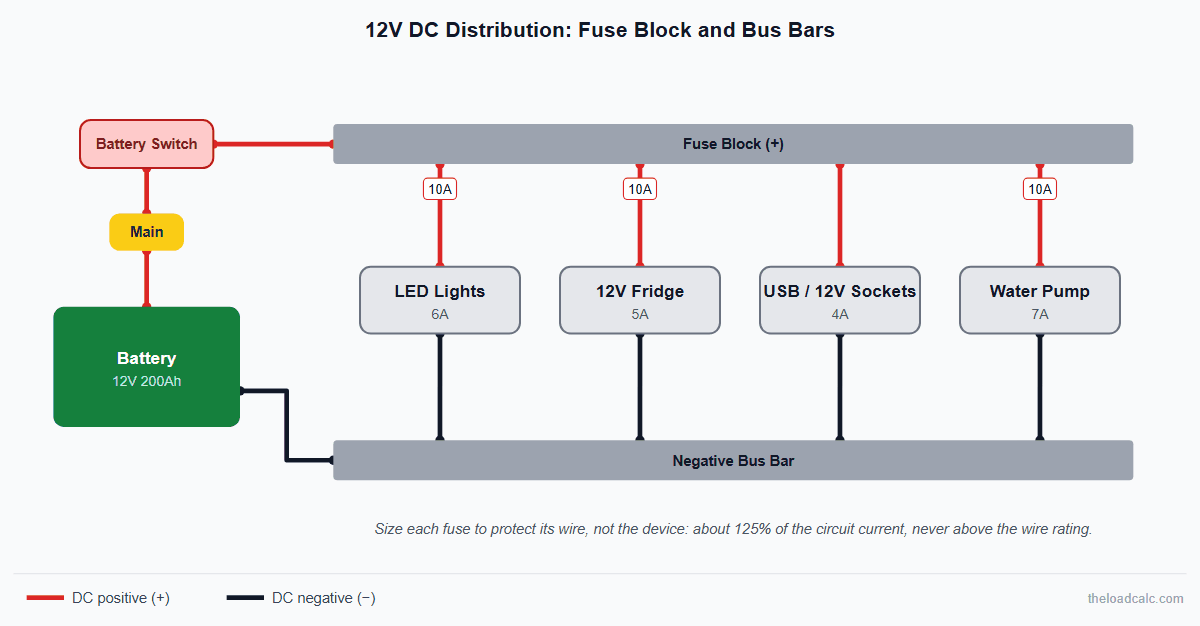
12V Fuse Block and Bus Bar Wiring Diagram
Distribute 12V power to lights, fridge, pump and sockets, each on its own correctly sized fuse.
Read more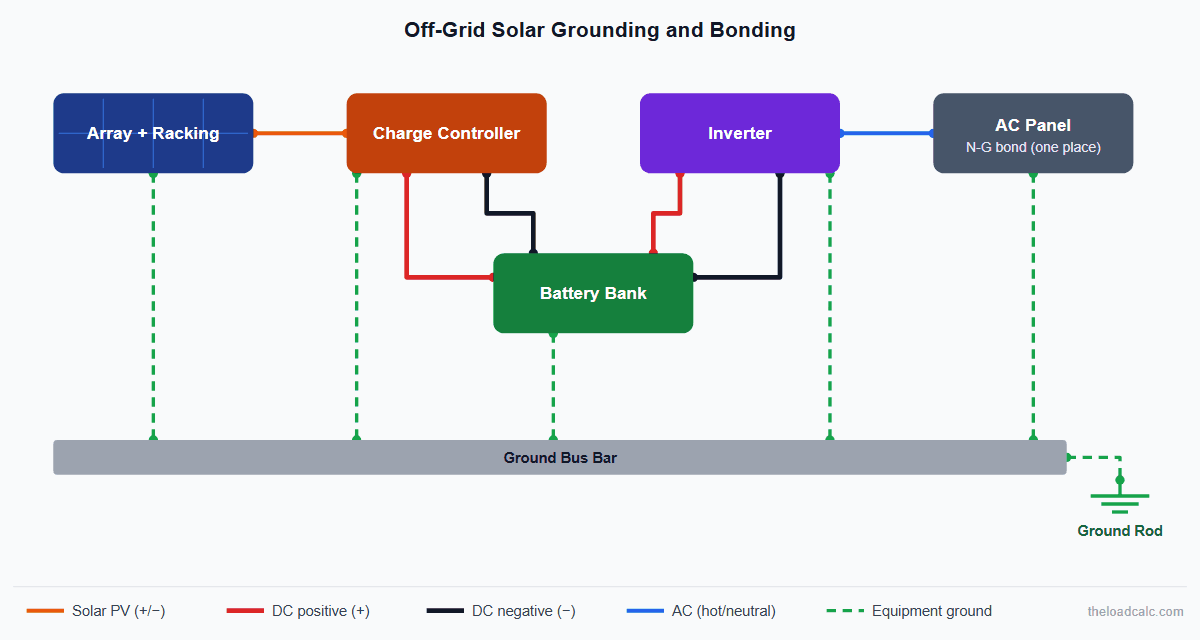
Off-Grid Solar Grounding and Bonding Diagram
Equipment grounds, the single DC bond and neutral-ground bonding explained in one diagram.
Read more
Solar Cables and Connectors: Wire Gauge, MC4s and Lugs
Picking wire gauge, PV cable and connectors, and crimping MC4s and battery lugs properly, so your system does not lose power or start a fire.
Read more
How to Choose a Solar Charge Controller
Current rating, maximum PV voltage, battery profiles and the cold-morning voltage check that protects your controller.
Read more