
Inverter to Critical Loads Subpanel Wiring Diagram
Move your essential circuits to a subpanel that the inverter keeps powered when the grid goes down.
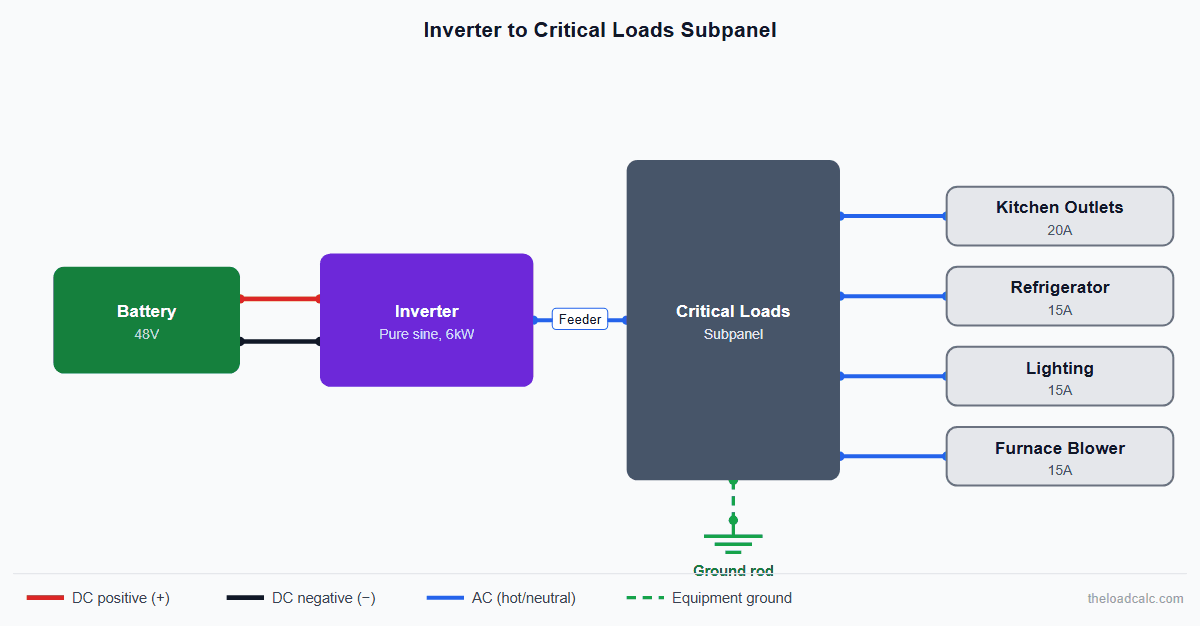
Most home battery inverters cannot run an entire house, so the usual approach is a critical loads subpanel. The circuits that matter in an outage, such as the fridge, furnace, lights and a few outlets, move from the main panel into a subpanel fed by the inverter. When the grid fails, those circuits stay on.
Key takeaways
- The inverter output feeds the subpanel through a feeder breaker sized to the inverter's output current.
- Choose circuits whose combined running load fits the inverter's continuous rating.
- In a subpanel, neutral and ground bars stay separate. Bond only at the service or source.
- A licensed electrician and a permit are required in most places.
Components
| Component | Typical spec | Role |
|---|---|---|
| Inverter or hybrid inverter | Continuous rating covers the critical loads | Powers the subpanel |
| Feeder breaker and wire | Sized to inverter output × 125% | Protects the feeder |
| Critical loads subpanel | 8-16 spaces, separate neutral and ground bars | Distributes backed-up circuits |
| Branch breakers | Moved from the main panel | Protect each circuit |
| Battery bank | Sized for outage duration | Energy storage |
Step-by-step wiring
- 1List the circuits you need in an outage and add up their running and startup loads.
- 2Install the subpanel beside the main panel.
- 3Run the feeder from the inverter's backup/AC output to the subpanel main lugs or breaker.
- 4Move each critical circuit's breaker and conductors from the main panel to the subpanel.
- 5Keep neutrals on the isolated neutral bar and grounds on the ground bar.
- 6Test transfer by switching off grid power and confirming every critical circuit stays on.
Disconnect all sources before working, follow the equipment manuals and local electrical codes, and use a licensed electrician for work on home wiring and panels.
Choosing what goes in the subpanel
| Good candidates | Usually leave out |
|---|---|
| Refrigerator and freezer | Central air conditioning |
| Furnace blower / boiler controls | Electric water heater |
| Lighting circuits | Electric range and dryer |
| Internet, a few outlets | EV charger |
| Well or sump pump (if inverter allows) | Space heaters |
Size the feeder breaker to the inverter's continuous output current × 1.25. For example, a 6kW inverter at 240V outputs 25A, so a 30-35A feeder. Use the inverter sizing calculator for startup loads, and see the hybrid inverter diagram for how the subpanel fits a grid-tied battery system.
Common mistakes
- Moving more circuits than the inverter can run at once.
- Bonding neutral and ground in the subpanel.
- Forgetting that motors (pumps, furnace) need startup surge capacity.
- Splitting a multi-wire branch circuit between panels.
Frequently asked questions
What is a critical loads panel?
A subpanel containing only the circuits you want powered during an outage, fed by a battery inverter so it stays on when the grid fails.
How many circuits can go on a critical loads panel?
As many as the inverter can run simultaneously. Add up running watts and the largest startup surge, and compare with the inverter's ratings.
Why are neutral and ground separate in a subpanel?
So normal return current flows only on neutral conductors. Bonding them in more than one place puts current on ground wires and metal parts.
Check your critical loads
Make sure your inverter can start and run them.
Related diagrams and guides
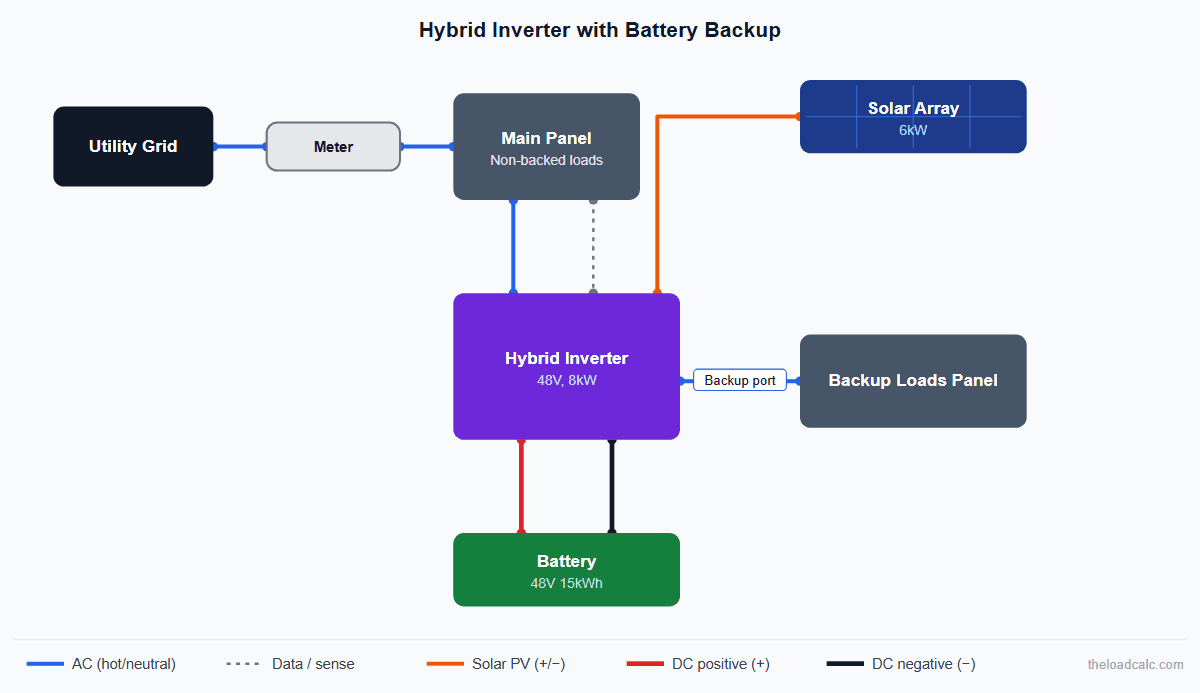
Hybrid Inverter with Battery Backup Wiring Diagram
Solar that keeps working in a blackout: grid, PV, battery and a backup loads panel all meet at the hybrid inverter.
Read more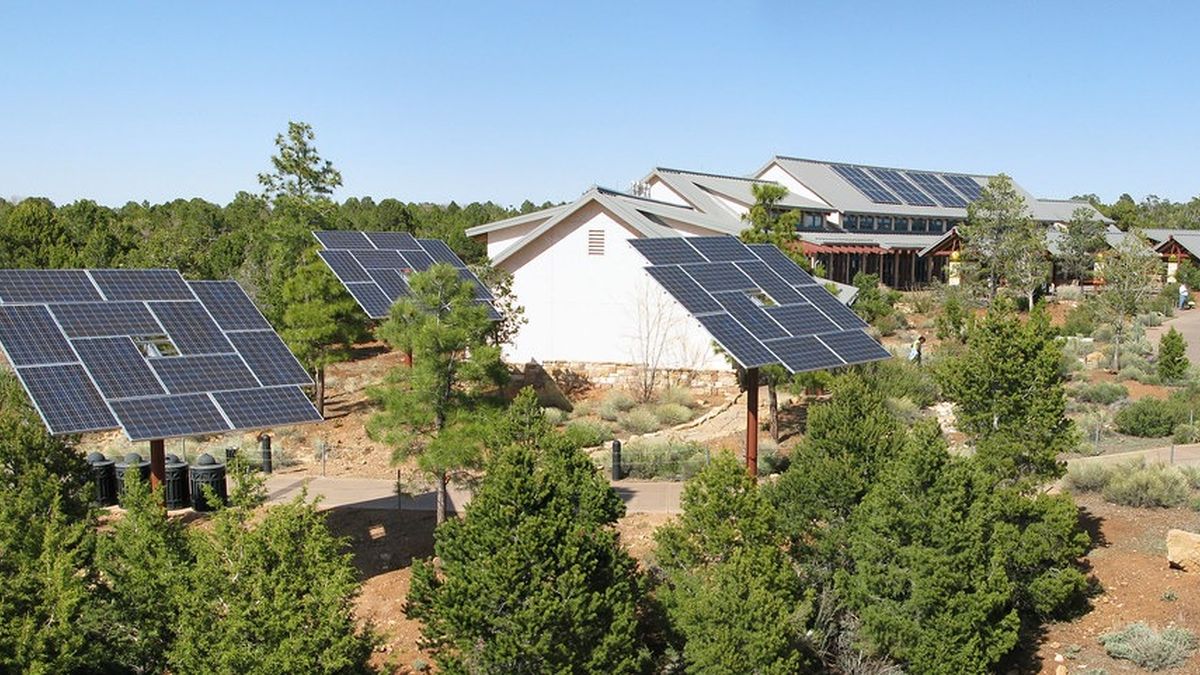
How to Choose an Inverter for Solar and Battery Systems
Continuous and surge ratings, inverter-chargers, idle draw and 240V output: everything that separates a good inverter choice from an expensive mistake.
Read more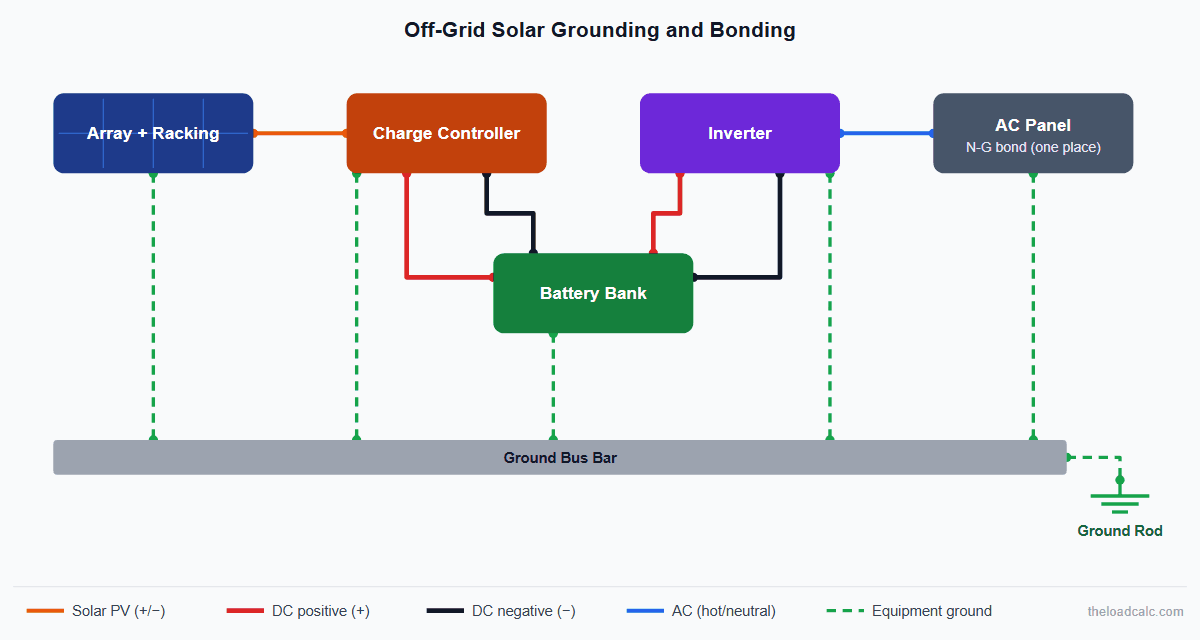
Off-Grid Solar Grounding and Bonding Diagram
Equipment grounds, the single DC bond and neutral-ground bonding explained in one diagram.
Read more
Hurricane Power Preparedness: Backup Power Before the Storm
Hurricane outages can last weeks. How to plan backup power, fuel and solar recharging before the storm, and stay safe after it.
Read more