
Solar-Direct Water Pump Wiring Diagram
Array, controller, pump and float switch: a battery-free system that pumps whenever the sun shines and stops when the tank is full.
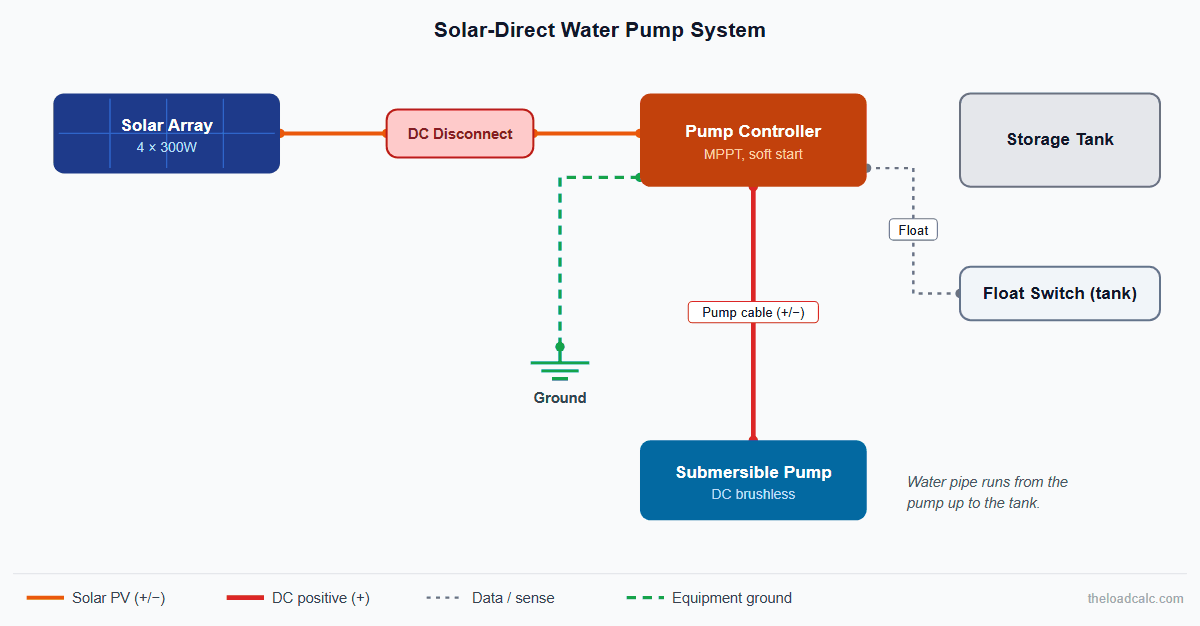
Solar water pumping is one of the most cost-effective uses of solar power. Instead of storing electricity in batteries, a solar-direct system pumps whenever the sun shines and stores the water in a tank. A pump controller with MPPT gets the most from the array, soft-starts the pump and stops it when the tank is full or the well runs low.
Key takeaways
- Store water, not electricity: a tank is cheaper and longer-lasting than batteries.
- The pump controller provides MPPT, soft start and dry-run protection.
- A float switch in the tank tells the controller to stop when full.
- Size the array at roughly 1.2-1.5× the pump's rated power to pump through more of the day.
Components
| Component | Typical spec | Role |
|---|---|---|
| Solar array | Sized to pump power and voltage | Power source |
| DC disconnect | Rated for array voltage and current | Isolation for service |
| Pump controller | Matched to the pump, with MPPT | Drives the pump efficiently |
| Submersible pump | DC brushless or AC with VFD | Lifts water |
| Float switch | Low-voltage signal type | Stops pumping when the tank is full |
| Storage tank | 2-3 days of water use | Water storage |
Step-by-step wiring
- 1Determine total dynamic head (lift + pipe friction) and daily water need, then choose a pump.
- 2Mount the array; run its output through the DC disconnect to the controller's PV input.
- 3Install the pump in the well with a safety rope and run the drop cable to the controller's pump terminals.
- 4Install the float switch in the tank and run its signal cable to the controller.
- 5Ground the array, controller and pump per the manuals and local code.
- 6Commission: check flow in full sun and confirm the pump stops when the float rises.
Disconnect all sources before working, follow the equipment manuals and local electrical codes, and use a licensed electrician for work on home wiring and panels.
Sizing at a glance
Hydraulic power (W) ≈ flow (liters per second) × head (meters) × 9.81 ÷ pump efficiency. Pump manufacturers publish curves showing flow per day for a given head and array size, and those curves are the best sizing tool. As a rule of thumb, DC submersible pumps for homestead wells run on 300-1,500W of solar.
The full process, including tank sizing and livestock needs, is in our solar water pumping guide. For conventional grid-style well pumps in an outage, see running a well pump during a power outage.
Common mistakes
- Undersizing the tank, so cloudy days mean no water.
- Skipping the float switch, so the tank overflows and the pump wears.
- Running the pump without dry-run protection in a low-yield well.
- Long, thin drop cables that starve the pump of voltage.
Frequently asked questions
Does a solar water pump need a battery?
Usually not. Solar-direct systems pump during the day and store water in a tank, which is simpler and cheaper than batteries.
How much solar do I need for a well pump?
It depends on head and daily water need. Many homestead DC pumps run on 300-1,500W of panels. Use the manufacturer's pump curves.
Can a solar pump run on cloudy days?
At reduced flow. MPPT controllers keep the pump turning in lower light, and a 2-3 day tank covers poor weather.
Estimate your solar output
See how much energy your array will produce for pumping.
Related diagrams and guides
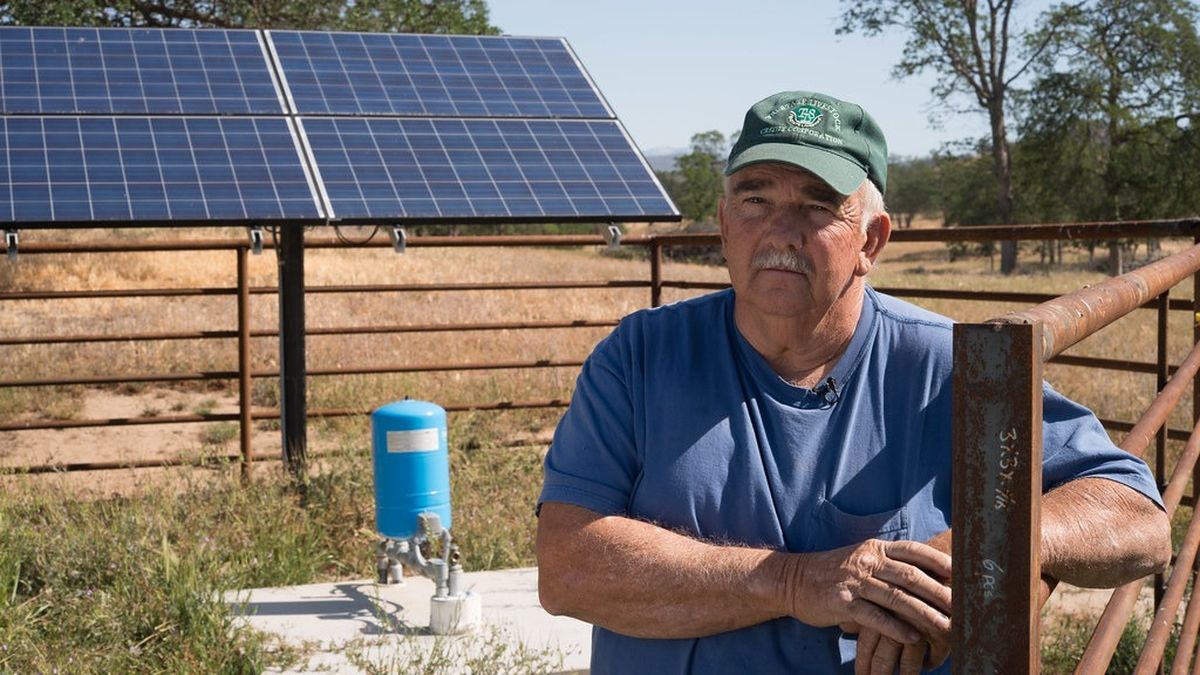
Solar Water Pumping for Wells, Livestock and Irrigation
Store water, not electricity. How to size a solar pump from head and daily demand, and build a system that runs itself.
Read more
How to Run a Well Pump During a Power Outage
No power means no water on a private well. A well pump uses little energy but a lot of startup current, and that changes what kind of backup you need.
Read moreSolar Panels in Series Wiring Diagram
How to wire solar panels in series to increase voltage, with a diagram and when series wiring is the right choice.
Read more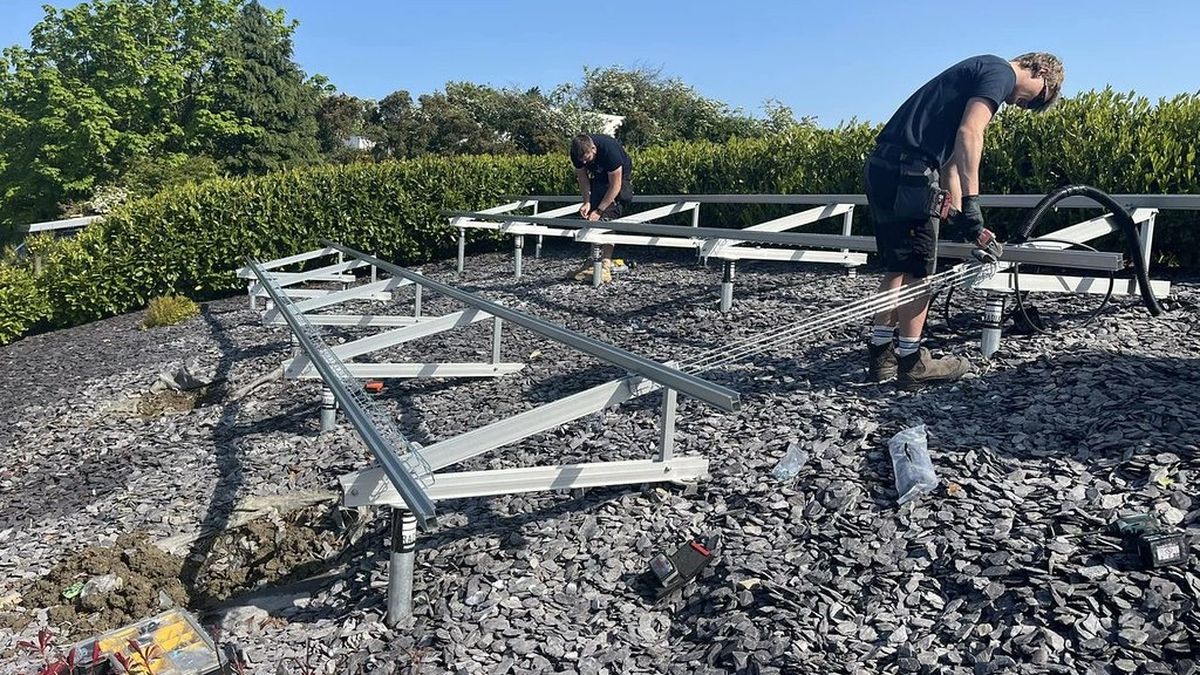
How to Install a Ground-Mount Solar Array
Siting, foundations, racking, trenching and grounding: how to build a ground mount that survives wind, snow and decades of sun.
Read more