
Split-Phase 240V Wiring with Two Stacked Inverters
Two 120V inverters, synchronized 180° apart, give you 240V for well pumps and dryers. Here is how it is wired.
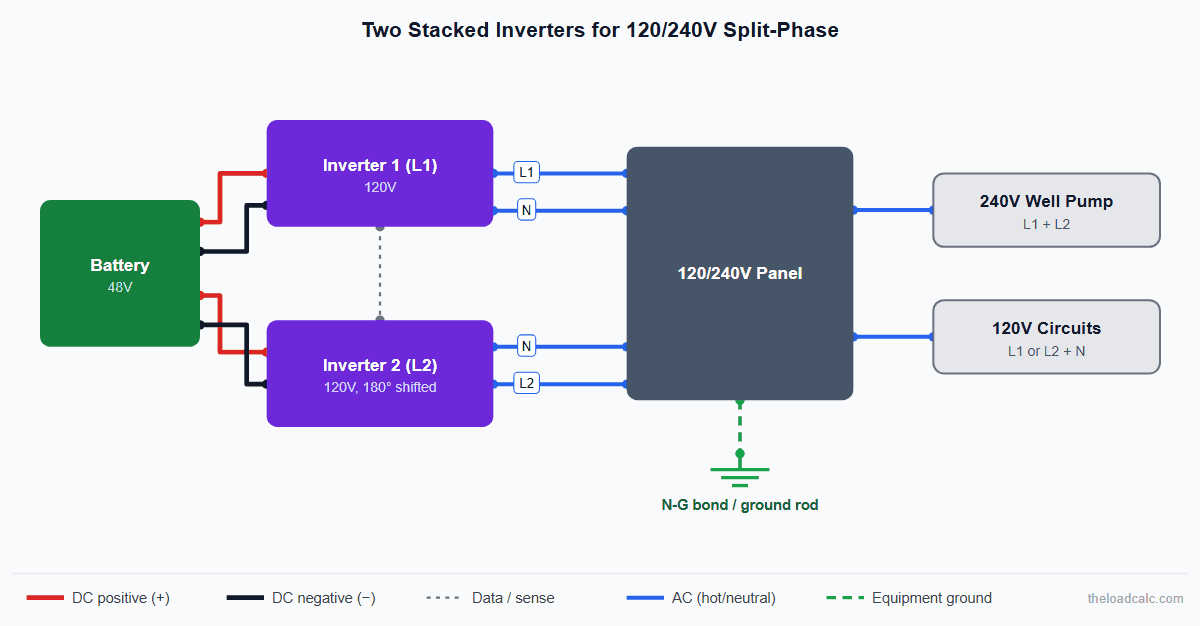
North American homes use 120/240V split-phase power: two 120V legs (L1 and L2) 180° apart, giving 240V between them for well pumps, dryers and ranges. Many off-grid inverters are 120V units designed to stack: two of them, linked by a sync cable, produce L1 and L2 with a shared neutral.
Key takeaways
- Two identical stack-capable inverters, linked by a sync cable, produce L1 and L2.
- 120V circuits use one leg and neutral; 240V circuits use both legs.
- The neutral carries only the imbalance between L1 and L2.
- Bond neutral to ground in one place only.
Components
| Component | Typical spec | Role |
|---|---|---|
| Inverters (2) | Identical model, stack-capable, 120V | L1 and L2 outputs |
| Sync cable | Manufacturer-supplied | Keeps outputs 180° apart |
| Battery bank | 48V typical | Shared DC source |
| DC fusing | Per inverter, sized to its draw | Protects each inverter cable |
| 120/240V panel | Split-phase load center | Distributes circuits |
| Double-pole breakers | For 240V circuits | Protect 240V loads |
Step-by-step wiring
- 1Mount both inverters and connect each to the battery bus with its own fuse and equal-length cables.
- 2Connect the sync/stacking cable and set one unit as master per the manual.
- 3Wire inverter 1's hot to L1 and inverter 2's hot to L2 of the panel; join both neutrals at the panel neutral bar.
- 4Wire 240V loads on double-pole breakers across L1 and L2, and balance 120V circuits between the legs.
- 5Make a single neutral-ground bond and connect the grounding electrode.
- 6Power up, verify 120V L1-N, 120V L2-N and 240V L1-L2 with a meter before connecting loads.
Disconnect all sources before working, follow the equipment manuals and local electrical codes, and use a licensed electrician for work on home wiring and panels.
Balancing the legs
Each inverter can only supply its own leg. If the 120V loads all sit on L1, inverter 1 can overload while inverter 2 idles. Spread big 120V loads across both legs. 240V loads draw equally from both inverters.
Many newer all-in-one inverters output split-phase from a single unit, which simplifies this. Compare options in how to choose an inverter. If you need 240V mainly for a pump, see running a well pump in an outage.
Common mistakes
- Mixing inverter models or firmware versions in a stack.
- Unequal DC cable lengths, causing uneven sharing.
- Putting all large 120V loads on one leg.
- Bonding neutral to ground in the inverters and the panel.
Frequently asked questions
Can two 120V inverters make 240V?
Only stack-capable models designed for split-phase, linked with the manufacturer's sync cable. Two unrelated inverters cannot be combined safely.
What happens if the legs are unbalanced?
The neutral carries the difference, and the more heavily loaded inverter may overload. Spread 120V loads evenly.
Do I need split-phase for an off-grid home?
Only if you have 240V loads such as a well pump, dryer or range. Many smaller off-grid homes run fine on 120V only.
Related diagrams and guides
How to Choose an Inverter for Solar and Battery Systems
Continuous and surge ratings, inverter-chargers, idle draw and 240V output: everything that separates a good inverter choice from an expensive mistake.
Read more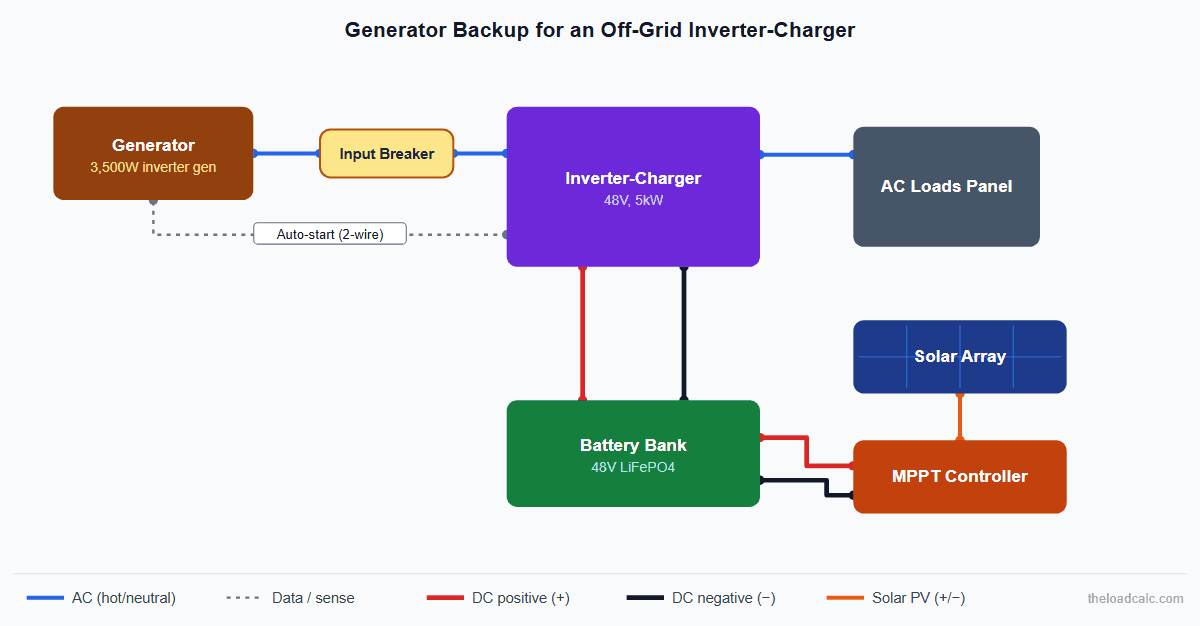
Generator Backup Wiring for an Off-Grid Inverter-Charger
Add a generator to an off-grid system so it recharges the batteries automatically during long cloudy spells.
Read more
How to Run a Well Pump During a Power Outage
No power means no water on a private well. A well pump uses little energy but a lot of startup current, and that changes what kind of backup you need.
Read more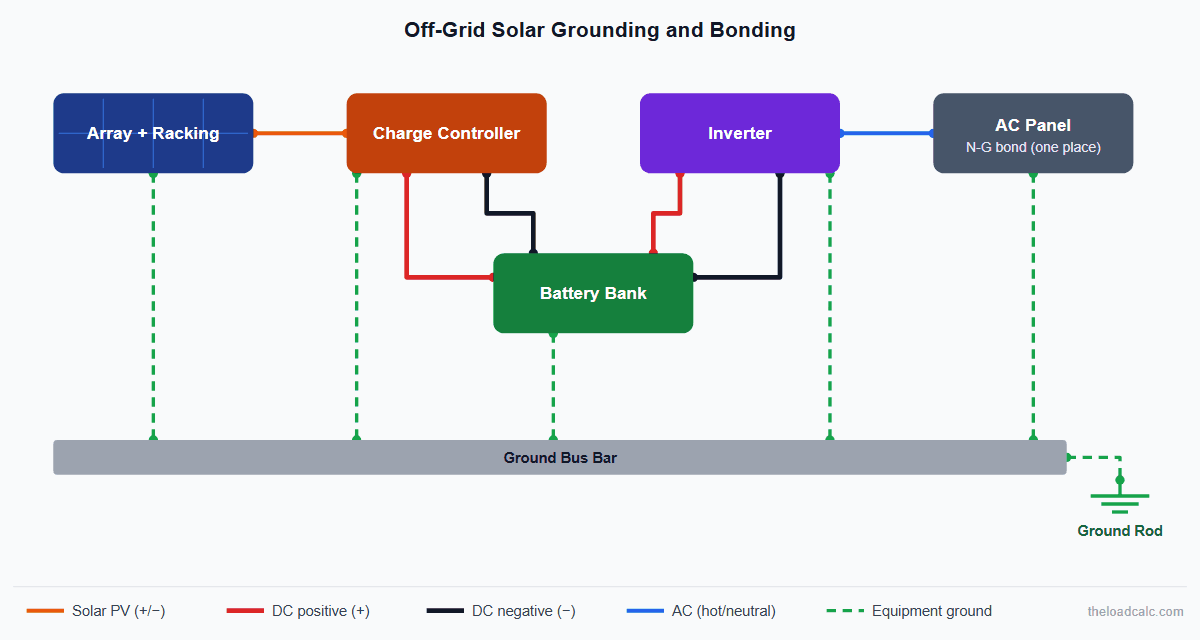
Off-Grid Solar Grounding and Bonding Diagram
Equipment grounds, the single DC bond and neutral-ground bonding explained in one diagram.
Read more